August 15, 2011

Berlin Awards Banquet (Part 1)

Finally the time had come to find out the results of the 2011 Design Competition! I had a great time trying out all of the design competition puzzles this year, and was interested to see what the judges thought of the puzzles.

Before the announcements, they served another very tasty buffet! We tried to get all of the folks from the Renegade puzzle forum together at one table, but there were too many of us! Instead we just got a picture of the whole gang. Not a bad turnout!


In the back row from left to right, we have Brett Kuehner, George Bell, Gregory Benedetti, Ronald Kint-Bruynseels, Rob Stegmann, Bernhard Schweitzer, Jim Strayer, and Brian Young. The bottom row has Stephen Chin, Mike Toulouzas, Jeff Aurand, and me.

In the puzzle design competition, there is a jury that awards the Jury Grand Prize, Jury First Prize(s), and Jury Honorable Mention(s). Puzzle party attendees also get to vote on their top five choices, and the puzzle that gets the most votes receives the Puzzlers' Award. Starting last year, they have also announced the Top 10 Vote Getters who weren't recognized with a Jury prize, which is a nice way of recognizing puzzles that a lot of puzzle party attendees liked.

Top 10 Vote Getters

Ambigram Burr was designed by Gregory Bendetti and beautifully crafted in the New Pelikan Workshop. The goal is to take it apart and re-assemble it. It looks like a normal board burr, but doesn't come apart the way you would expect. Since I don't think it spoils too much, I'll be describing generally how it comes apart, so skip the next paragraph if you don't want to know.

Rather than six pieces, it actually has four pieces that separate into two halves. Each half then twists apart quite nicely. It isn't difficult to take apart, but putting it back together can be a bit tricky due to the rotational move. The graceful thing about this puzzle is that each piece is identical, right down to the coloring, if I remember correctly.

Overall, I liked Ambigram Burr, it was really nicely made and the design has an elegance to it. The only downside for me is the simplicity, I like something a bit more challenging. That said, it did take me a bit to put it back together, it is definitely not entirely straightforward.  Particularly if you didn't see how it came apart, it could be even more challenging.

If you're interested, you can purchase it from Bernhard Schweitzer through his PuzzleWood website, if any are still available!

Next is Breakfast Egg by Vesa Timonen. The goal is to take it apart and put it back together. Vesa has designed one of my favorite Hanayama puzzles: Cast Loop, so I always am interested to see what he's up to. This particular puzzle looks like an egg, with the yellow yolk visible through a hole in the white. There is a seam that runs along the white that you can sort of see in the picture. It is a bit reminiscent of his earlier work, Tangerine, though it works differently.

I actually found this one to be pretty challenging: I thought I had the general idea but it didn't end up working like I expected! It turns out that there is a rather devious dead-end that I had been pursuing that kept me occupied for quite a while. Eventually I figured it out, I think maybe 20 minutes later. It is doable but definitely not easy.

I liked Breakfast Egg, the appearance was whimsical and it had a simple mechanism but challenging solution. The only downside I can think of is that it is a bit fiddly getting things positioned correctly. Also it would be a bit more pleasing if the pieces were smoother. The 3D printing process used here left the pieces a bit rough when they slide along one another. Overall, I really liked the simplicity of the mechanism, but it still took a while to figure out.

Next is Carpenter's Rule by Kelly Snache. It as a really nice looking puzzle box, so I was looking forward to giving this a try. I really liked the joints he used on the corners of the box, and the re-use of an old ruler for the top of the box was quite clever.

This one took me about 10 minutes to solve and was enjoyable to work through. Kelly sometimes puts clues in his puzzles, but in this case I found it more difficult figuring out what the clues were hinting at than to just approach the puzzle head-on, which is one drawback (depending on your perspective).

Particularly since I have seen a number of puzzle boxes, I prefer a box with a really unique mechanism, which was what was lacking for me in this puzzle. Still, the craftsmanship on Carpenter's Rule is very nice, and I really like his re-use of materials in his boxes: it gives it a great rustic look! Also, there are some cute surprises hidden inside, which is also a nice touch.

Curly Cube by Vladimir Krasnoukhov is one that I had seen for sale at Puzzle Master, but hadn't gotten around to trying yet. I thought I had a pretty good idea of how it worked, since it looks similar to George Hart's 3-piece Screw-Together Cubes. However, it is completely different!

The way this one works is fundamentally similar to a number of other puzzles out there, but the way it looks is quite unique. This appearance also makes it a bit trickier to get back together than you might first expect. Still, I didn't find this one to be too challenging.

I think the most impressive aspect is that they were able to craft this puzzle out of wood! While it doesn't have the snuggest fit due to being mass-produced, the tolerances are fairly good and the angles of the cuts look pretty tricky!

Overall, Curly Cube is solid little puzzle available for an affordable price. I don't think most puzzlers will find it to be very challenging, but it is a cute novelty item that particularly non-puzzlers will enjoy for its simplicity and appearance.

Drunken Dancing Fraulein by Stephen Chin is a very unique-looking puzzle. It is a bit hard to tell in the photo, but it is a top that is sitting on a stand. The goal is to take apart the top to find a diamond inside. It is crafted out of a solid piece of wood with very little waste. There is a whistle on the top, and three trapped rings around the spindle. Due to the trapped rings it wobbles when you spin it, hence the name Drunken Dancing Fraulein (a.k.a. Drunken Dancing Ballerina).

With all that is going on in this puzzle, it feels like there are a number of places to start, however I found that I reached a dead-end fairly quickly with each path I took. After a few minutes, I found the way to proceed: it isn't particularly difficult but could definitely keep you thinking for a bit. After this first revelation, I found the rest to be pretty straightforward, but satisfying.

Stephen later told me about an interesting physical principal that is at work in this puzzle, which I found quite interesting. Unfortunately, I can't really say anything about it without giving a hint about the solution! There is another cute thing about this puzzle that you don't really discover until you start solving it.

Here's a photo of Stephen coming back from receiving his award. I really thought Drunken Dancing Fraulein was a great puzzle, with an interesting and unique mechanism that was challenging but not impossible to solve. The only downside I can think of is that it is possible on some copies of this puzzle to get a particular piece stuck, and it can be a bit of a challenge to get it back out again. You'll know what I'm talking about if you get to that point in the puzzle. That said, you don't need to risk getting a piece stuck in order to solve the puzzle, so if you're about to do that, don't bother! If you do get it stuck and are having trouble getting it out again, feel free to contact me for a tip that Stephen gave me.

Finally, we have Tornado by Pantazis Houlis, Arcady Dyskin, Alexei Kanel-Belov, Elena Pasternak, and Yuri Estrin. The goal of this puzzle is the same as their entry last year One Four All and All Four One: place all four pieces inside the  frame in such a way that no piece is loose.

I found this one to be a bit simpler than last year's challenge, perhaps since it has a somewhat similar trick. I don't think it took me much more than five or ten minutes to figure this one out. The solution has a nice appearance, and finding it could prove pretty challenging if you haven't seen a puzzle like this before. No real drawbacks to this one other than the fact that it is a bit similar to last year's puzzle. Perhaps it would have been a bit easier to manipulate if the pieces were somewhat larger.


Ok, that's all of the Top 10 Vote Getters! Congratulations to all these great puzzles! I was planning on getting through all of the award winners tonight, but it is getting late and I've got to head out, so look for the rest tomorrow!

August 12, 2011

Berlin Puzzle Party

On Sunday was the actual puzzle party where buying and selling of puzzles occurs. I was looking forward to seeing what puzzles would be for sale, I had my eye on a few from the puzzle exchange, but you never know what you'll find. As soon as 9:00AM hit, folks went rushing into the room to try to snap up puzzles before they sell out.

Since there wasn't a particular puzzle that I was after that I thought was going to sell out, I  first did a quick sweep of the room to check for anything particularly rare that I was looking for. Any interesting puzzle boxes, for example. There was one table that was selling a bunch of Karakuri Club boxes, but nothing that I was interested in buying.

I did stumble across a puzzle by the mysterious Roger called Alles Roger at Marcel Gillen's table. I immediately recognized it since I had seen it in pictures a number of times before. Roger's puzzles are quite hard to come by and the price was good, so I purchased it immediately. Check out Oli's blog for a review and photo. (At the end of this post there is a picture with all of the puzzles I got.)

I went by Pavel Curtis's table and picked up a copy of his newest puzzle, also his exchange this year, called Edgewise. Per his usual style, it is a multi-level puzzle where each step leads you on to the next. This one is in the form of a 25 piece jigsaw puzzle with letters written on it and no edges, which presumably makes it pretty tricky to assemble. I have really enjoyed his work in the past, so I thought I would check this one out as well.

I bumped into Dick Hess who was also walking around, and inquired as to whether he had any of his exchange puzzle for sale. Fortunately he did, so I ended up purchasing that as well. As I mentioned in my previous post, they are two wire puzzles where the goal is to get the cowboy back on his steer (invert the position of one piece). Clever idea! I looked forward to trying it out.

Someone was selling this brass puzzle that looked kind of cute: it was a brass cylinder with a coin inside, and the goal was to free the coin. I played around with it a bit and eventually discovered the solution, it is a fairly standard trick but nicely done! I didn't end up buying it. In this photo, you can see Namick Salakhov from Azerbaijan playing with it.


Another puzzle I tried out and didn't end up buying was this exchange puzzle by Marcel Gillen. It is nicely crafted out of aluminum, and the goal is to separate the two pieces. It had me a bit stumped at first, but after playing around with it a bit I figured it out. I didn't end up getting this one because I found it a bit too easy to stumble upon the solution without knowing what you did, which I find less satisfying than one where you really have to think to find the solution.

One place where I spent a lot of time was lusting over this beautiful table full of puzzle locks. On the right hand side were a bunch of antique puzzle locks that were way too expensive for me, but still fun to look at. Rainer Popp and Friedhelm von Knorre, who gave the talk about puzzle locks on Saturday, were manning the table and let me try out a few of these antiques.

I figured out the first one that I tried pretty quickly, and Rainer suggested that I check out another one. He said it used a common trick but was very well executed. Sure enough, it stumped me for a good while! With a few hints from Rainer, eventually I figured it out and was amazed by how well hidden the secret was on such an old lock. Sorry, but I didn't get a picture of it!

On the left hand side of the table were all of Rainer's locks, which were extremely tempting! I would love to have his full set of locks, but it would pretty much blow my puzzle budget for quite a while, so I resisted. Hopefully I can be satisfied with trying copies that other people purchase for now!

I mentioned to Rainer that I particularly enjoyed solving his T4 lock, and he was quite surprised that I was able to solve it without looking at the solution. He said for that lock most people had to look at the solution, so I was pretty proud to have figured it out. It was fun talking with him about my approach for solving it and how I figured out the one main tricky step. It sure is a tough lock, but I really love that design!

I shopped around a bit more and bought a few more puzzles, but I think I mentioned most of those yesterday. Here's a photo with everything I came back with:


Starting in the back row on the right: Grid Sticks Cube 4 by Sandor Bozoki, Piggy Box Puzzle by Stewart Coffin made by Saul Bobroff, Drunken Dancing Ballerinas from Stephen Chin, and Houdini's Torture Cell by Brian Young. Next row: Double Pyramid by Vaclav Obsivac, IPP31 Puzzle Gift by Markus Gotz, a random wire puzzle, Crazy Bottles by Jean-Claude Constantin, and Edgewise by Pavel Curtis. Third row: Columbus Egg by Anker Stone, Alles Roger by the mysterious Roger, The Rodeo Riders by Dick Hess, and Laby Box by Jean-Claude Constantin. Last row: Z-shift by Peter Hajek and The UTC Puzzle by Kohfuh from Nick Baxter.

Quite a haul! That should keep me busy for a while!

After I finished at the puzzle party, I headed back over to the design competition room to try to finish making my way through the puzzles and cast my votes for the best puzzles of the year. Here's a photo of me in the design competition room, puzzling away.

Next up, the awards banquet!

August 11, 2011

Berlin Puzzle Exchange Day

Saturday was the day of the Puzzle Exchange! For those of you not familiar with the International Puzzle Party, the puzzle exchange is where each participant brings many copies of a single puzzle to exchange with other participants in the exchange. Folks register for this in advance so everyone knows how many puzzles to have made and to bring. The puzzles need to be new (i.e. not available before the exchange), so it is a great chance to add a bunch of new items to your collection.

I wasn't exchanging this year since my collecting is more focused on boxes, and very few boxes are available in the exchange. However, each exchanger can have one assistant who helps keep track of which puzzles they have received, so I was helping out Stephen Chin. In addition to being helpful to him, it gave me a chance to figure out if I wanted to try to buy any of the exchange puzzles the following day at the puzzle party!

Stephen had a pretty incredible exchange present this year: he was exchanging Drunken Dancing Fraulein, one of his design competition entries. I'll write more about it when I get to my reviews of the design competition puzzles, but it is a beautifully hand-crafted top that is also a whistle and a puzzle box! I may be a bit biased, but this was my favorite puzzle in the exchange so it was fun helping give them out to everyone.

We wandered around the room crossing people off our list as we gave and received puzzles from each person. There were a number of good puzzles, though unfortunately the Sandfields, Perry McDaniel, and Matt Dawson weren't exchanging: I would have looked forward to seeing what they came up with since they're also into puzzle boxes.

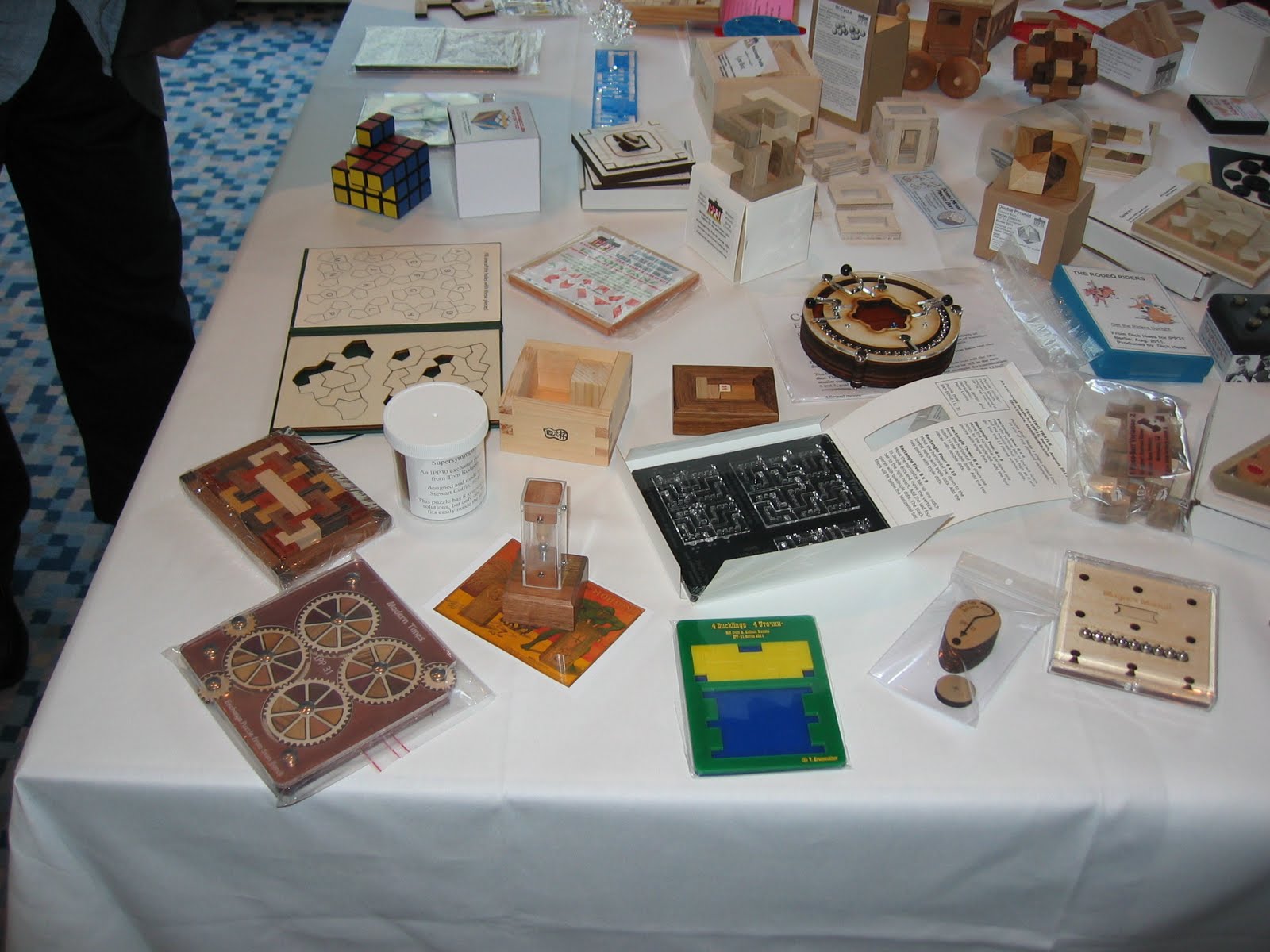
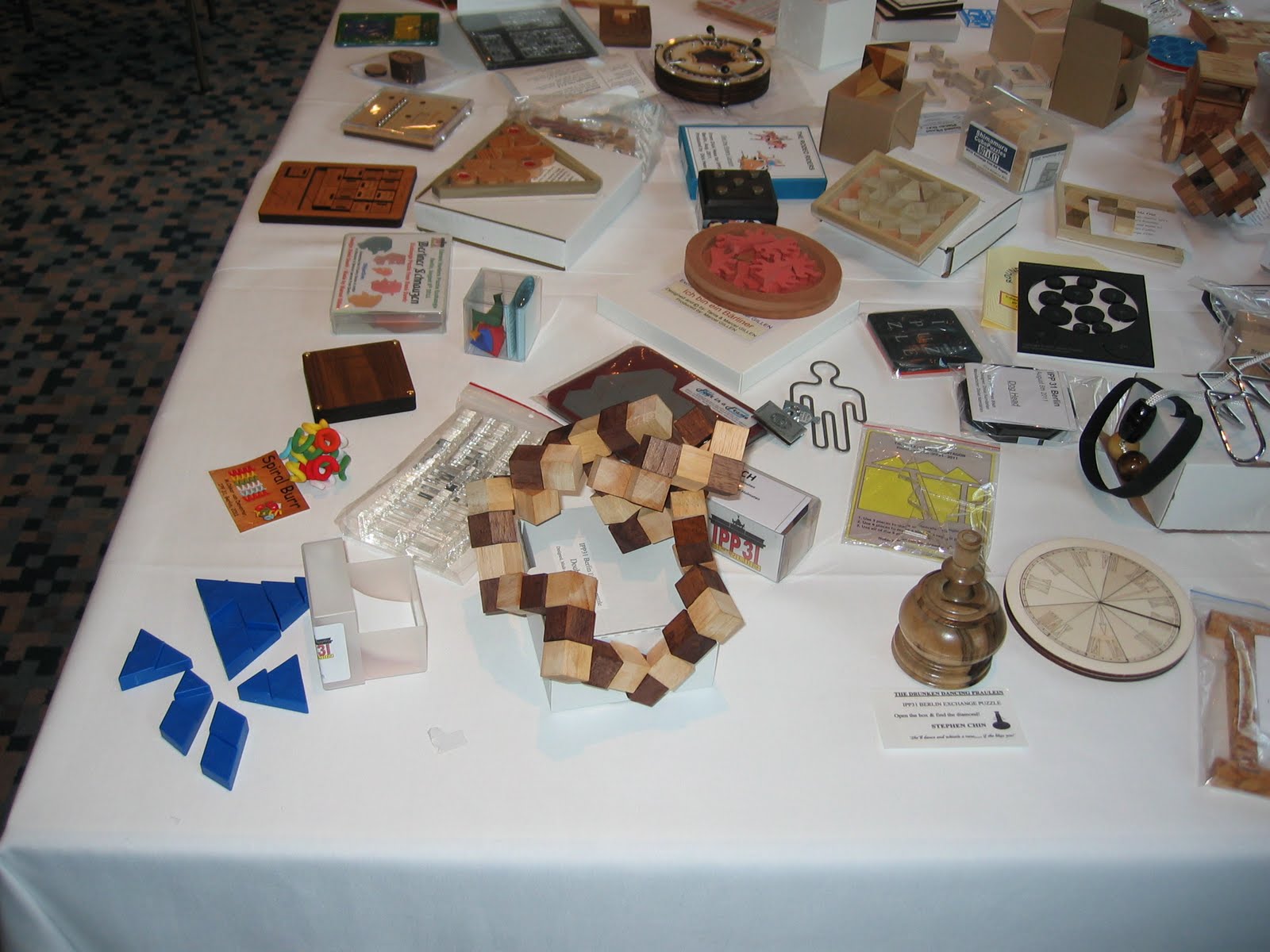
Folks put one copy of each puzzle on the exchange table so everyone can see all the puzzles un-packaged in one spot. Here's a bunch of pictures as I walked around the table, you can click for a larger version:


Iwahiro, another puzzle designer that I keep an eye on, exchanged Gem Box which is in the upper left of the photo. It is a fairly large box that you're trying to put four octahedrons inside. I was thinking about getting this one, but didn't end up buying it since I was able to solve Stephen's copy. It is pretty good, but I didn't enjoy it quite as much as MMMM (one of his other puzzles).


I ended up purchasing two puzzles in the photo above: the round one near the center of the picture is Crazy Bottles, which simulates the situation where you have bottles of different known sizes and are trying to get a particular volume left over (see Three Jug Problem). It was designed by Jean-Claude Constantin and exchanged by Manfred Ullrich.

I also purchased the one with the clear, square, plastic piece on a wooden base called Houdini's Torture Cell designed and exchanged by Brian Young. This one is based on the final lock in his The Opening Bat puzzle: it is such a cool mechanism he wanted to make it a bit more widely available and easier to show to people, which I thought was great. If you actually got the bat, you probably don't want to look at this one until you've solved the bat. Full reviews to come in subsequent posts once I've had some time to play around with them more.


I was thinking of purchasing the box with the five bolts on the top in the upper left corner of the picture above, but after solving Stephen's copy I didn't end up getting it. It is called Reach Open Space and was exchanged by Tatiana Matveeva. The mechanism is not bad, but not quite interesting enough that I wanted to purchase it.

I did end up buying Dick Hess's exchange, which is in the box directly to the left of Reach Open Space. He created two wire puzzles where the purpose is not to remove a piece, but rather to flip a piece upside down. It had a rodeo theme: the idea was to get the cowboy back on the Bull/Steer. Topographically they are the Boromean Rings that he frequently uses in other puzzles (The Yak, The Whale, and The Brontosaurus).


In the bottom right of this photo you can see Stephen Chin's Drunken Dancing Fraulein. Isn't that a nice looking puzzle? In the bottom left is Tanya Thompson's which is an interesting variation on the traditional crossed sticks design. It was produced by Logika Spiele, so I'll bet that will be commercially available at some point, which is good.


I ended up purchasing the reddish box in the center of the table called Laby Box that was designed by Jean-Claude Constantin and exchanged by Hendrik Haak. It is basically two sliding mazes that are linked together by three sets of two pins that need to be slide up and down while the mazes are slid left and right to open the box. It is a bit simpler than it sounds since it is all visible, but does take a number of steps to open. I'll bet this one will be pretty readily available from places where you can buy Constantin's work.


Overall, a solid batch of puzzles! Sorry that I can't go into detail on all of them, but that would take a while and I haven't actually played with them all. Let me know if you have questions about any of them in the comments and I'll do my best to answer them. Thanks to Stephen for letting me help out in the exchange! Here's a photo of Stephen exhausted from gathering all this loot.

After the exchange, I headed over to the design competition room where I logged a few more hours. This was the time when the lectures were going on, and I decided to skip most of them in favor of playing with the design competition puzzles.

I did attend one presentation by Rainer Popp and Friedhelm von Knorre's on puzzle locks, since I love Ranier's work (check out his site at Popplock.com). He talked a bit about some design decisions and challenges he faced in some of his designs, which was quite interesting. However, I've only solved T3 and T4, so I had to shut my eyes and plug my ears when he was talking about the others. I didn't want to spoil the others since I'm hoping to have the chance to solve them at some point.

Next up was the banquet! The banquet was quite good, plenty of food and it was really tasty too! Again folks were pretty hungry, so there was a stampede for the buffet when it first opened. Fortunately our table was pretty close so I got some food without waiting too long. I sat with Rob Stegmann (Rob's Puzzle Page) and his daughter Chelsea, George Bell, Brett Kuehner and his family, Richard Gain (Microcubology) and his son Adam, and Tanya Thompson from ThinkFun.

There were a few presentations about upcoming puzzle parties in the US, Japan, and Europe, and then some performances. There was an odd fellow who was the MC and also did a bit of pop-and-lock dancing and break dancing. There was someone who was an expert in memory techniques who taught us a technique for memorizing a list of random words. There was a stunt bike-rider who did some pretty cool tricks, I think that was probably my favorite of the performances.

After dinner, folks hung out for a bit and chatted. I went down to the lobby to hang out and do some puzzles. I brought a few of the puzzles that Stephen got in the exchange with me so I could try them out before I decided whether or not I wanted to buy them the next day. I think I mentioned them already above with the photos of the exchange table, so I won't go through them here.

Coming up next, the actual puzzle party!

August 10, 2011

Berlin Tour and Founder's Reception

The following morning (Friday) I had signed up for the guided tour of Berlin. Since the rest of the weekend is packed with puzzling, this was the only day I really got to see the city. Lots of other folks were on the tour as well, including Dick Hess, Brian Young, and Trevor Wood.

It was great seeing the sights of Berlin, particularly in the company of other puzzle people, since I do enjoy talking about puzzles. We started out on a bus tour that took us by a number of sights including the Berlin Cathedral (right) and some remains of the Berlin wall.

I was surprised by how thin the wall was! Not much more than six inches, I'd say. However it is extremely strong, according to the tour guide. I think it was due to the amount of reinforcing rod used, as you can see a bit in the photo. He said it could stop a tank!

After a while on the bus looking at a number of sights, we finally stopped at one: Charlottenburg Palace. This is the largest palace in Berlin and dates back to the end of the 17th century. Unfortunately, we couldn't take photos inside without buying a permit, but here's a photo of the outside.

After that, we headed over for a riverboat tour, which took us down the river Spree. By this point we were all really hungry, but unfortunately there wasn't any time in the schedule for lunch! Luckily for me, my roommate Stephen had snagged some food from the breakfast buffet which he shared. Thanks again, Stephen! Jeff got a nice photo of me and Stephen below.


After the boat tour, we headed over to the Reichstag building, where the German parliament meets. This was a really beautiful building! It had a magnificent glass dome on the top that we got to walk up into, and there was a great view of the city. Unfortunately it was a bit rainy at this point so my photos didn't turn out very good. Instead, here's a photo of this really cool mirror array in the dome that brings natural light down to the parliament.

That was the end of the tour, so we made our way back to the hotel. At this point it was around 5:30, so I had a few hours to kill before the 7:00 founder's reception. Of course, I decided to head over to the design competition room to get in a bit of puzzling before the reception.

The reception itself was good, I had a chance to chat with a number of puzzlers, though I spent a good bit of time chasing down food. It was only hor devours rather than dinner, so folks were pretty hungry and ended up staking out the location where the waiters were exiting the kitchen. When each one came out, puzzlers descended upon them quite quickly. After getting my fill, I was happy to see that they had brought the design competition puzzles into the room, so I could spend a bit more time working on them. You can see me hunkered down on the window-sill in this nice photo Jeff took.

After the reception, they moved the puzzles back to the competition room, where I of course followed them. After another hour or so they closed up the room and I headed back down to the lobby.

In the lobby I ran into the prolific and brilliant puzzle designer Oskar van Deventer, who was showing around some of his newest inventions. The one he is holding looks a bit dull: just two cubes connected by a rod, right? No, this was probably one of the coolest twisty inventions I have seen in a while: The two cubes are connected so if you rotate one face, the other correspondingly colored face rotates! It is called the Dumbbell Cube and you can check out a video demonstration from Oskar here. There is an interesting gear system that drives the whole thing, very cool idea!

Another interesting one is called the Oh Cube (video). It looks more or less like a regular cube with the cuts proportioned somewhat differently, but in fact you twist the corners rather than the faces, as you can see in the photo. The stickers were peeling a bit and getting jammed in the mechanism, so I didn't play around with this one.

Well that's it for now! Next up, the puzzle exchange and banquet.

August 9, 2011

Trip to Berlin

Well I'm back from my trip to the 31st International Puzzle Party in Berlin, and I had a great time! Sorry for not blogging while I was over there, but I was too busy trying to pack in all the puzzling that I could. Also, sorry for not updating the blog in a while: I was quite busy with the wedding and honeymoon, but I'll be posting regular updates again now.

The flight to Berlin was pretty long, but fortunately my lovely wife loaned me her iPad so I was able to watch Battlestar Galactica the whole way over. This was entertaining enough that I was able to stay awake for the whole trip, which I think is key to avoiding jet lag. I try to stay up till midnight or so in my destination, then with a full 8 hours of sleep I'll be on the right time zone.

It turns out that Jeff Aurand, a good puzzling friend of mine was on the same flight to Berlin, as was John Rauch! So we had a good time chatting while we waited for our flight out of JFK airport. Unfortunately, the flight was delayed by over 2 hours, which isn't any fun on an already long trip.

We were supposed to arrive around 10:00 AM in Berlin on Thursday, but ended up getting there closer to 12:30 PM, which ended up working out OK since we arrived late enough that we could check into our rooms right when we arrived. I was sharing a room with Stephen Chin from Australia, and he arrived a bit earlier than I did. Brett Kuehner and his family had also arrived, as had Jim Strayer and his wife.

I was starving, so ended up getting some food at a Vietnamese place with Brett (left) and Jeff (right) that was really good. The hotel was in a great location, there were a number of places to eat nearby, though I ended up eating at the hotel most of the time since I didn't want to miss any puzzling!

When we got back I was thrilled to find that the design competition room was open! I didn't expect it since the party doesn't really get started until Friday. This is my favorite part of IPP since I get to play with a ton of new puzzles! I'll be doing a separate series of blog posts on the design competition puzzles, so I won't go into any detail on that here. So after lunch, I camped out in the design room for a good 4 hours, headed out to grab some food with Stephen and then went back to the design room until they kicked me out.

After that, it was getting to be pretty late, but I wanted to stay up a bit later to hopefully reduce the effects of jet lag the next day. A bit of a tradition at IPP after the official activities have ended is to hang around in the lobby and play around with puzzles, so that's where I headed next.

Here's a photo with Frans de Vreugd showing his collection of Chinese cricket puzzle to William Waite and Tomas Linden. They were really nicely made and had such well-hidden seams that it was actually quite difficult finding how it opened.

None of them had any tricky locks, they just had sliding panels that were very well disguised. Here's a photo of two of them from William Strijbos who sells them. They are so perfect and intricate that it seems like they must have been carved by some computer controlled machine, but it is still quite cool. I didn't end up buying any, but I definitely can appreciate their beauty.

George Hart brought a few of the designs he printed on a 3D printer (Maker-bot) and I took a crack at assembling them. Sorry it is a bit hard to see what is going on in the photo. I need a new camera! The one in the lower right wasn't too tricky, but the one in the upper left was tough! The pieces wind around in an unusual way, it was difficult figuring out where they needed to go, as well as holding them in position while you add additional pieces. Once you get the last piece in, it clicks into place nicely and holds everything in place.

Stephen brought out some of the great things he's been working on. Here he is demonstrating a design he built by Stewart Coffin called Expanding box, which he turned into a sphere on a lathe. It looks quite cool and has a nice expanding motion. He actually tied a string on the inside to prevent it from being expanded all the way, so you can enjoy the movement without worrying about it collapsing on you. On the table you can see a bunch of pens he made too!

Eventually I ended up heading to bed at around 12:30, what a long day! Tomorrow was the tour of Berlin and the Founder's Reception that kicks the weekend off.

June 13, 2011

Cast Starfish

Cast Starfish is the fourth in a series of six marine-themed Hanayama Cast Puzzles designed by Akio Yamamoto. Puzzle Master sent me a copy of this puzzle to review. Thanks!

Like the others in the series, it is made out of contrasting gold- and silver-colored metal. This one has a particularly unique appearance, with the bumpy texture of the starfish.

I was quite interested to see how this one would work, since it looks like your usual ring-with-a-gap type puzzle, like Cast Claw, but there are no grooves to navigate the ring through. Quite peculiar!

I played around with this one for a bit, and was pretty confused, it took me a while to discover the unique movement that is needed, and I really liked it. The first time I solved it, I didn't really fully understand it, I was more just fiddling. But with a bit more thought and practice, I saw that it had a nice logical progression, which I liked.

This one is rated a 2/6 by Hanayama, which seems about right. It is tougher than Cast Seabream and Cast Shark (both 1/6), and also more difficult than Cast Claw (2/6). I think it probably took me about 10 minutes, but folks have had a pretty tough time with it when I give this one to people.

Speaking of letting people try these puzzles, I noticed something a little alarming when I brought the series to a party yesterday: the gold color is starting to wear off! This is quite disappointing since the contrast is what makes these so visually appealing. Ah well, just something to be aware of, I definitely wouldn't stop letting people play with them because of that, but I'm a bit surprised that Hanayama would have that issue since their puzzles are generally very good quality.

Back to Cast Starfish: this is one of my favorites of the marine series due to its interesting movement and the pattern that you slowly discover. I have a great time watching folks play with this one, since there is a good "A-ha!" moment when they discover the movement, and another when they finally figure out how it comes off. Definitely worth checking out!

June 10, 2011

Always Empty Puzzle Box

I recently acquired this lovely box made by Phil Tomlinson of WolfAngel Studios. Phil is a very experienced woodworker with 35 years of experience in cabinet making and woodworking. I think this is the first puzzle box he has made for sale, so I was quite eager to check it out! It was made in a limited edition of 30. I was particularly curious about the name: how could it be "always empty"?

As you can see from the photo, the box is quite striking visually. The contrasting light and dark wood give it an interesting look, and the red inlay on the top catches the light beautifully. In the right light, it almost looks like it is hovering above the surface. (Photo by Phil)

It was quite a bit larger than I expected from the picture, about 5 inches long in the longest dimension. When I started looking at it, I was also struck by its weight: it felt quite dense, making me wonder what interesting stuff could be going on inside!

I actually had the puzzle shipped to Kellian's office, since packages have been stolen from my building before, so I was even happier to see her than usual when I picked her up that evening and she had a box waiting for me. We were headed to a swing dance, but we were a little early, so we sat in the car for a bit while I gave the box  try (and Kellian patiently read her book).

At first, I was quite stumped, I wasn't able to get anything to move! After about 5 minutes, I finally made some progress, but immediately hit a dead end again. After a bit more fiddling, I decided to give it a rest and go to the dance.

When we returned home, I started back at it, determined to figure it out before I went to bed. After a little while, in a flash of inspiration, I had an idea for how it might work and I ended up being correct. It is a cute move that I haven't seen before, though it is related in a way some other puzzles. It doesn't quite end there, there's one more move for a total of three, but I found this last move fairly quickly. The "always empty" aspect of the box is cute, though somewhat related to a classic idea. Sorry to be vague, but I don't want to go spoiling it for you!

I think it took me about 25-30 minutes to solve, which was perfect. I'm actually surprised that it took me that long, now that I know how it works I'm curious why I didn't stumble upon the solution earlier. In any case, I'm glad that I solved it the way I did, since it is much more satisfying to have an idea that proves to be correct rather than to simply succeed through random prodding and pulling.

One nit-picky note: the description of the puzzle describes it as having "a little coordinated motion", but, strictly speaking, I wouldn't describe it as coordinated motion. It does have something in common with coordinated motion puzzles, however, which is the aspect that Phil was probably referring to.

I tried this box out with my friend Clayton, who has gotten pretty good at solving puzzle boxes, and he opened it in about 5 minutes. He actually used a different method than I did, and I was surprised that I hadn't noticed it before. I was glad that I found the intended solution, since it is more fun than this alternative one.

In all, Always Empty Puzzle Box is a very nicely crafted box that I'm glad to have purchased! I'll definitely be buying more of Phil's work in the future if I can: this box sold out quickly so you'll have to move fast if you'd like to acquire his work. It will likely be sold at Puzzle Paradise, so make sure you're on the email list if you'd like to be notified when new puzzles are available there. A few other bloggers have written about this puzzle as well, so check out: Neil's Puzzle Blog and Jeff's Puzzle Blog to read more.

Phil has also created some magnificent puzzle cabinets for displaying your puzzles, and the cabinet is actually a puzzle as well! What an awesome idea. It has integrated lighting and temperature/humidity sensors. How cool is that? Check out this link for more great pictures of the cabinet. If you're interested and would like more information, contact me and I'll pass it along to Phil.

June 8, 2011

Cast Claw

Cast Claw is the third in a series of six marine-themed Hanayama Cast Puzzles designed by Akio Yamamoto. Puzzle Master sent me a copy of this puzzle to review. Thanks!

As with the rest of the marine series, this one is cast in contrasting gold and silver. In this one, a mackerel is caught in a crab's claws, and you task is to free it!

By looking at it, you may think that it similar to Cast Bike: a ring with a gap that must be navigated through slots. However, the profile of the ring is such that there is a bit of additional complexity, albeit not a ton.

This one is ranked a 2/6 on Hanayama's scale, and I found it fairly easy to solve. I think it took me about 2-3 minutes, since I'm pretty familiar with this type of puzzle. There were a few little interesting parts that slowed me down a bit, but generally it was pretty straightforward. The ending is somewhat unusual for this type of puzzle.

I would say it is slightly more difficult than previously reviewed Cast Shark and Cast Seabream, mainly because it has a somewhat longer solution. I liked it a bit more than Cast Seabream, but not as much as Cast Shark. Overall, a good little puzzle, but not one of my favorites in the series.

June 7, 2011

Cast Seabream

Cast Seabream is the second in a series of six marine-themed Hanayama Cast Puzzles designed by Akio Yamamoto. Puzzle Master sent me a copy of this puzzle to review. Thanks!

Like the rest of the series, Cast Seabream is finished in contrasting gold and silver, with a brilliant shine. It has a sturdy feel and a good weight in your hand. The two fish, a seabream and mackerel, are quite nicely sculpted as well.

Like Cast Shark, which I wrote about yesterday, this is rated a difficulty level of 1 on Hanayama's scale, which goes to six. After a bit of fiddling, this one came apart pretty easily, probably in about 3 minutes. Folks that I gave this one similarly had a pretty easy time with it.

The solution path felt pretty straightforward, there are a few obstructions, but generally it works like you would expect. As such, it wasn't one of my favorites of the series.

One annoying aspect is that there isn't really an easy-to-identify starting position, which can be problematic if you are just passing this puzzle around. Folks may leave it very close to the solution, so others will find it trivially easy. I had to check the solution to figure out where the start was, since I had forgotten.

One cool thing I found out in looking at the solution is that this puzzle will actually stand upright! You can balance the gold fish on his fin, which in fact provides three points of support. If you get the silver fish in the right spot, it will balance nicely. While it isn't super-stable, it will stay like this provided your table/shelf isn't bumped too hard, which looks pretty nice!

In all, I thought this was a good puzzle, but one that you could pass on if you're not intent on collecting the whole series.

June 6, 2011

Cast Shark

One group of Hanayama puzzles that I haven't tried yet has been the Cast Marine series: six puzzles that are all sea-themed and designed by Akio Yamamoto, the same person who designed many of my favorite Hanayama's, such as Cast Baroq, Cast Vortex, and Cast Dolce. Puzzle Master was kind enough to send me this group of puzzles to review, so I'll start off with Cast Shark.
One thing you will notice among Yamamoto's designs is that he pays quite a bit of attention to the appearance of the puzzle, which I really appreciate. Cast Shark is no exception, with a nasty shark's jaw trapping a poor fish.

The fun thing about this one is that it has a narrative to go along with it: will the fish be eaten (exit through the back) or freed (i.e. exit through the front of the teeth). The exciting tale is revealed as you solve this puzzle! This aspect easily makes this one of my favorites in the marine series.

On top of the cute narrative, the puzzle itself is pretty good: there are a number of dead ends to lead you astray, as well a unique movement that is pretty fun to do. It isn't particularly hard to solve, most should be able to get it in under 10 minutes, I think it only took me a minute or two. As such, it would be a good one to give to first-time puzzlers, particularly with the narrative.

Another thing I liked about this one is that it has a solid starting position where the pieces latch together nicely for display. Note that the starting position is not shown in the picture above, sorry!

As is the case with many curvy designs like this one, sometimes it is hard to tell if you can make a particular move, since it may just be that you don't have the pieces positioned quite right. As such, folks may be tempted to force this one, but it is quite sturdily built so it should take the abuse nicely.

In all, Cast Shark is a fun little puzzle, definitely worth checking out. Stay tuned for the rest of the marine series reviews!