February 4, 2011

Meffert's Megaminx

Previously I have reviewed the Megaminx offered by ThinkGeek, and thought that it was an interesting puzzle but it jammed frequently. Puzzle Master recently sent me a version of the Megaminx produced by Meffert's, a manufacturer of high-quality twisty puzzles. I was quite interested to see how this version compared to the version I already owned.

The first thing I noticed is that the movement is much, much smoother. The ThinkGeek Megaminx locked up incessantly, but this one jams quite a bit less. It still is an issue, but it is much better in this version.

Meffert's Megaminx has PET stickers, which are known for wearing out and falling off, so that's a bit unfortunate. Serious speed-cubers will want to replace these stickers with better ones, but that's not my cup of tea so I won't be bothering to do that. Here's a photo of the ThinkGeek Megaminx stickers for comparison. You can see that they're thick plastic, and aren't likely to fade or peel. They could fall off, but you can just glue them back on.

Another gripe I had about this puzzle is the color choice. Generally, it is not bad, but for some reason they chose to have two shades of orange on adjacent faces, which is quite confusing. I found myself needing to move to an area with better light so I could tell the difference. There is also a blue and teal that are quite easy to confuse. The ThinkGeek version also had this issue, but at least similar colors were not adjacent. I guess it is hard to choose 12 colors that you can't confuse!

There were also a number of spots where the stickers were pretty far off center. Not a big deal, generally, but some are close to the edges which makes me worried that they'll get caught and peel off.

With all the gripes I'm pointing out, you'd think that I didn't like this puzzle! Despite all of this, I'd definitely recommend getting a copy: it is about $30 while the ThinkGeek Megaminx is $10, but the much smoother operation is defnitely worth it.

If you haven't tried a Megaminx, this is definitely a good twisty puzzle to try if you want something significantly more difficult than the Pyraminx. I think most people will be able to solve a good amount of it by thinking their way through it, but the last layer is difficult. If you get stuck, there is a great solution algorithm posted here.

January 31, 2011

Bandage Cube

Bandage Cube is another puzzle I received from Puzzle Master to review. Thanks Puzzle Master! This puzzle was produced by Meffert's, who makes some great quality twisty puzzles. As you can see from the photo, it looks great and it turns just as nicely.

The interesting thing about this puzzle is that it uses a 3x3x3 Rubik's Cube as a base, but certain cubes are 'bandaged' together with thick stickers that cover more than one cuby! This makes it so that certain rotations are not possible. As you may imagine, it is quite tricky!

Throwing caution to the wind, I went ahead and scrambled this one up. It took a bit more effort to scramble than a regular cube because you need to look to find a move that is possible now and then.

I worked on this one for a good hour or so, and haven't yet been able to restore it to its solved state. I was able to get two layers solved, but the top layer has been vexing me thus far. As is usually the case, getting the last few pieces in place without screwing up everything else you have done is pretty tricky! I'd love to talk to somebody about how they approach a puzzle like this. How do you come up with the algorithm? I can come up with simple ones, but the long ones are tough for me. Leave a comment if you've got some insight!

As I mentioned earlier, the quality of this puzzle is quite nice. I liked the thick plastic stickers, though their thickness is probably also for structural purposes. I don't really have anything bad to say about it other than the fact that it is tough! It is quite annoying not to be able to make a move due to the way this thing is constructed, but that's the whole idea I guess!

If you'd like more info on this puzzle, check out Jaap's Puzzle Page. He's got a ton of information, including solutions, to many twisty puzzles. A great site!

Overall, Bandage Cube is a fun twisty puzzle that should be in your twisty collection. Definitely not for the feint of heart, but a good challenge! I'm hoping to solve it someday, but that's what I said about the Square 1 that I got during my last twisty puzzle spending spree.

January 27, 2011

2010 Karakuri Club Christmas Presents (Part 3)

To start off my final post about the 2010 Karakuri Club Christmas Presents, I've saved Akio Kamei's Parcel Box. I saved it for the end because this is the box that took me the longest to solve, and it is also the one that I'm a most on the fence about whether I like it or not.

The external appearance is much like his earlier works Parcel and Parcel Cube. I like the use of dark and light wood: if you look closely, you'll see that the pattern of the straps on the outside is arranged like borromean rings. This gives the appearance a nice symmetry.

I struggled with this one for quite a while! At first, it appears like a solid block, nothing will budge. Due to the design, there are lots of things to try sliding. Eventually, I found something ever so slight that hinted at the solution. I spent quite a while fiddling with this subtle thing that I found before I finally figured out how to solve it. In all, I think this one took me maybe 2-3 hours spread out over a few days. It is a tough one!

The thing that irks me about this puzzle is that the actual solution is awkward. It does have an unusual move for a puzzle box, but actually physically executing this move is challenging. With a little practice, I got the hang of it, but that aspect annoyed me a bit. The thing that I really liked about this puzzle is that the solution is simple, but non-obvious. I always enjoy a challenge that ends up having a simple solution like this, since all sorts of crazy complicated solutions go through your head while you are trying to solve it.

This last puzzle box is by Hiroyuki Oka and is named
Double Puzzle Box. He sort of gives away a bit of the surprise in the description of the puzzle, so I would avoid reading it if you can.

The external appearance is nice, with a cool checkered yosegi pattern. Since it appeared to be proportioned like a traditional Japanese puzzle box, I tried the usual things, but nothing worked! However, I soon figured out what I was doing wrong and discovered the first part of the solution.

Based on some clues, I knew I wasn't done yet and proceeded to solve it completely. It isn't too challenging, but there is a nice little surprise at the end. That said, there isn't really anything that is all that novel about this box. I prefer puzzle boxes that have something that I've never seen before, and this has (pretty much) been done before. There is one aspect about the 'surprise' that was a bit surprising and out-of-the-ordinary, but that still didn't quite do it for me. Still, I will continue to purchase Oka's Christmas Presents, since his last few have been pretty clever.

That's it! I can hardly wait until next Christmas already! Getting these puzzles is pretty much the highlight of my puzzle-buying for the year.


All posts in this series:
Part One
Part Two
Part Three (you are here)

January 25, 2011

2010 Karakuri Club Christmas Presents (Part 2)

To lead off my second entry about the 2010 Karakuri Club Christmas Presents, I've chosen Hideaki Kawashima's Snake Cube, since it is another one of my favorites this year.

It has a striking appearance, with the red wood contrasting with the light wood. Due to the arrangement of the panels, the pattern looks a bit different depending on which angle you look at it. I prefer the angle shown in the photo, since the three red panels swirl together nicely. Kawashima mentioned that he named it Snake Cube because of its appearance, but I don't really see the snake aspect. Still, I like it!

It only took me a few moments to find the first move, and I progressed fairly quickly after that. The solution requires more than 10 moves, but they progress in a logical pattern. That aspect of the solution is what I really liked about this puzzle. Kawashima mentions that he had a number of possible solution patterns to choose from based on the underlying mechanism, and this was his favorite. I agree that he chose well!

I think most will find this to be moderately difficult, but not too bad. I've shown it to a number of people, and the place where most get stuck is actually the last move where you remove the lid. I think most folks who are into puzzle boxes will have seen this before, but less experienced folks may not expect it the first time they see it.

It is a nice looking box that is an interesting variation on a sliding-panel box. Not too difficult, but still enjoyable and satisfying solution. Overall, I really liked it!

Next up is Tipsy by Tatuo Miyamoto. He posted an interesting description of this one: "The theme for this work is 'Drunk Japanese Fathers'. After an evening of drinking late with other company employees, Fathers often bring home some kind of food or snack for their families. A common food is sushi."

I don't quite understand the story in relationship to the box, aside from one small aspect. It may make more sense in Japanese! I won't reveal which aspect, so I don't give away too much.

The box has a nice appearance, but is surprisingly light. This is due to the very large compartment inside, which some may like. Unfortunately, this lightness makes it feel a bit like a cheap Bits and Pieces puzzle box, but the construction quality still seems to be up to snuff (other than the issue I note below). I'm not a big fan of the ribbon sticking out of the middle.

This one probably gave me the most challenge out of the six boxes I purchased, aside from Kamei's box which I will write about tomorrow. It seems pretty impeneterable at first. After a minute or two, I discovered something, and was pretty delighted by what it implied. Even getting to this step is pretty challenging, and after that it is a bit puzzling what to do next. Due to a combination of clues, however, I was able to piece together the next step. The mechanism is actually related to another puzzle he has made, which I think helped me slightly.

It is at this point that the puzzle gets a bit annoying: after the 2nd step on this one, the box should just open. However, it does require a bit of unintended fiddling to actually get it to release. I wondered if this was part of the solution, and confirmed on the solution sheet that it was unintentional. Oh well! It makes for a bit of an added challenge, even though not intended. Still, I would have preferred for it to work as intended.

For this reason, I don't like this box as much as the others I got this year. That said, I did have a good time solving it and am glad that I purchased it. Even with the lesser boxes, you still can't really go that wrong with the Karakuri Creation Group!

Tomorrow, I'll write about the last two boxes I purchased this year.

All posts in this series:
Part One
Part Two (you are here)
Part Three

January 24, 2011

2010 Karakuri Club Christmas Presents (Part 1)

Every year, the Karakuri Creation Group introduces a new set of puzzle boxes at Christmas time. The interesting part is that members actually pay for these boxes in advance, between January and June, having no idea what they will receive! Each box is $100, and you can choose the craftsman, but they have creative liberty to make what they'd like. If the boxes produced by the Karakuri Creation Group weren's so consistently impressive, this would be a hard model to sustain, but their boxes are conistently top-notch.

This year I ended up splurging a bit and getting six. Last year I only got three and regretted it a bit, since there were so many cool ones that I didn't end up getting. This year, I chose to get boxes from Akio Kamei, Hiroshi Iwahara, Yoshiyuki Ninomiya, Hideaki Kawashima, Hiroyuki Oka, and Tatuo Miyamoto.

I will start with Iwahara's House with Trees box (shown above) because it was the first one that I tried and it is one of my favorites this year. As you can see from the photo, it is a magnificent looking box. The different colors of wood used are very nice. I particularly liked the reddish wood used for the corners, it makes for a very unique and striking appearance.

There are four small trees on the top of the box, pointing in various directions. This is reminiscent of his Box with Tree which has a single tree on it. Iwahara provides this hint in the description: "The direction of the trees are a hint in solving the box." Pretty interesting, eh?

I found out quickly that a few things moved, but soon came to a dead end. With Box with Tree in mind, however, I was able to figure out the solution moments later. Had I not been familiar with this earlier puzzle, I think that this could have taken me much longer. The solution is interesting and makes sense when you know it, but is pretty difficult to figure out. Even more interesting is the mechanism that is involved, I would love to see a diagram of it!

I think the main downside to this one for me is that it was so easy if you know Box with Tree. I think I would have had a lot more fun/frustration if I hadn't solved that box first. As a puzzle, I actually liked it a bit more than Box with Tree, though both are cool.

In all, this is one of my favorites (if not my most favorite) of the Karakuri Club Christmas Presents this year. The solution and mechanism are interesting, and it has a great appearance. Iwahara is definitely a craftsman to keep your eye on!

Next up is the somewhat un-eloquently named "Irregular Open 4 Times Secret Box" by Yoshiyuki Ninomiya. Ninomiya is the master craftsman who taught Akio Kamei, and is in his 80's. It is quite impressive that he is even still designing and producing puzzle boxes at this point! He surely gets help from other Karakuri Creation Group craftsmen, but it is still impressive.

This year, due to Ninomiya's age, he only produced a limited number of boxes. Because of this, a lottery was held for who gets to purchase his boxes! It sounds a bit absurd, but purchasing one of his boxes for $100 is an excellent deal since he won't be making them for much longer. I was lucky enough to be able to buy one after winning the lottery, and I jumped at the opportunity.

The first thing I noticed was the beautiful yosegi patterns that decorate each side. The top is different from the bottom as well. Due to Ninomiya's superior craftsmanship, there are no visible gaps along the edges. This leads you to wonder how the box could possibly open!

After fiddling with it a bit however, I was able to open it quickly. I was disappointed to find that it is a simple 4-move secret box mechanism, no tricks! The movement is a bit stiff, but it will likely loosen up over time. I'm still happy that I purchased it because of its beauty and craftsmanship, but I wish he had added a little something more creative and puzzling. In 2011, he is not producing a Christmas present, so I'm glad that I got his 2010 present.

I'll write about the remaining four boxes this week, so stay tuned! In the meantime, check out Jeff Chiou's blog entry on the three boxes he got.


All posts in this series:
Part One (you are here)
Part Two
Part Three

January 18, 2011

Perpetual Hinge Puzzle Box

Back in December I purchased Robert Yarger's latest box: the Perpetual Hinge Puzzle Box. There are hinges on each of the four sides of the box, forming an endless loop. How could it open? Needless to say, I was quite intrigued. The photo is by Jim Strayer, one of the few people with a complete set of Robert's work. Check out the full list here.

Here's an excerpt from Robert's description:
While not as complex as some Stickman puzzles, this box does not skimp on “aha moments”.  Its devious and unique solution requires a minimum of at least 13 steps, and accessing its 4 hidden compartments can stump the most profound of sleuths. 
While I wasn't too thrilled that he said that it wasn't as complex as some of his other work, I did like the fact that it was less expensive than Gordian Knot Puzzle Box and potentially even more difficult! The fact that it has multiple compartments was also appealing.

I've found that I'm frequently surprised that the actual size of Robert's work is different from how I envisioned it: Gordian's Knot was smaller than I expected given all the small details, but Perpetual Hinge is quite large at almost a foot long! I think this is a good size for it though, given the mechanisms involved. It makes it quite sturdy, so I don't feel too worried letting other folks try it out.

It is crafted out of jatoba and white oak with leopardwood hinges, which gives it a fairly simple but nice appearance more reminiscent of his earlier work. As Jim notes, the mechanical-looking appearance is also a return to Robert's roots. It was produced in a limited edition of 28.

I started working on this one right away, curious to see how long it took me to find the first compartment. I checked the clock before I started and as I worked on it realized that this puzzle may be more challenging than I bargained for! I found a number of things that moved and felt like I was starting to make some progress in understanding the movements, but I still couldn't quite get it open. After about 30 minutes, I set it aside to return to later.

That evening, I again worked on it for a good 30 minutes, if not more, but didn't make any real progress. I did make one observation, but couldn't figure out how to use it. This repeated for a few days, and I decided to bring it to my parents' house for Christmas, hoping that I could make some progress. While I was there, I was suddenly able to see how to use the observation I had made earlier. It is very clever and subtle!

With this puzzle, it is quite easy to keep going around in circles thinking you are making some kind of progress. I enjoyed this since I was eventually able to figure it out, but I think a lot of folks will get frustrated and give up at this stage. Those folks should be encouraged to think outside the box, so to speak, and not keep trying the same thing. Life lessons through puzzles!

So I had accessed the first compartment and went on to find the second. I was somewhat relieved to find that it follows fairly easily after you get the first one. Of course, the rest of the puzzle couldn't be that easy: the 3rd and 4th proved quite elusive! I again set the puzzle aside to return to later.

The next day, again I found myself going in circles not making much progress. I really needed to think and not just fiddle mindlessly. I had a few ideas for how it might work, but none of them seemed to pan out. Several days later, when I was at my wit's end, I found the next step, which reveals the last two compartments!

In corresponding with Robert, he mentioned that this wasn't quite intentional, he had hoped for the fourth to require additional steps, but it didn't quite turn out that way. Still, I don't think that it is a problem at all, it was still a real beast to solve! In all, I think it took me more than a week, and probably somewhere around 5-10 hours to solve.

As far as downsides, some might not like the simpler appearance of this one or the fact that it is fairly large, but that didn't bother me. The main thing that folks may not like is the red-herring aspect that can get you going in circles like I mentioned earlier. I thought it was done fairly and with enough to get you going in the correct direction, but some might not like this feature. Indeed, Robert was initially reluctant to include this type of feature in his boxes. However, he had a change of heart when inspired by Peter Hajek's work:
My thought had always been that a puzzle was not really a puzzle unless it could be solved entirely by logical deduction, and I never was one for discovery on random chance. I was greatly intrigued by [Peter Hajek's] past IPP entry with the matchsticks and that giant red dot that really did nothing. I changed my views a bit on such puzzles at that time, and realized that the requirement of abstract thought in a solution was also a valid form for a puzzle. After all, the solution to many everyday problems often requires moving out of pre-conceived patterns of logical thought.
It is interesting to hear his thoughts on it, and I totally agree. Of course, it is the task of the puzzle designer to make sure that the correct path of abstract thought is possible at some level, and I think Robert did a good job with this.

Overall, I think this is an excellent puzzle that I'm very glad to have purchased. I don't think I like it quite as much as Gordian Knot, but that's currently my all-time favorite puzzle so it is hard to compete!  I can't wait to see what Robert comes up with next!

Check out Jeff Chiou's blog entry about this puzzle as well to read about his experience.

January 11, 2011

Lunatic Lock

Lunatic LockLunatic Lock is another puzzle that I purchased a while ago but haven't written about yet. I got it from Bits and Pieces, though you can buy it from Amazon, Puzzle Master, and a bunch of other places. I like puzzle locks, and this one is pretty cheap at $15. It was designed by Gary Foshee.

The finish on it was pretty crummy, sort of like this photo. The body is a brushed finish that had some dings, and the shackle is more polished but scuffed up. Also, the edges of the body could have used more of a bevel, they are a bit sharper than I'd like.

Despite the lackluster appearance, it is actually a pretty nice little puzzle. I think it took me a good 15 minutes or so to solve, but it could easily take a lot longer. It is possible to just randomly stumble upon the solution, and I'd bet that a lot of people solve it this way. After inspecting the parts, you can figure out what you did to solve it. If I remember correctly, I actually more or less deduced the solution, which was quite satisfying. Sometimes you just guess about how these things work and happen to be correct, but other times you can be way out in left field!

Overall, a solid puzzle that is worth checking out, just don't expect too much from the appearance and you won't be disappointed! Definitely not as awesome as DanLock, the best puzzle lock I've seen, but much more affordable.

January 7, 2011

Hercules

Hercules was designed by Jean Claude Constantin and produced by Bits & Pieces. They were having a sale last month, so I decided to pick one up. I wanted to try it because Rob Stegmann lists it on his "Today's Starter Kit" list of 22 puzzles. I've got about 11 of these so far and have enjoyed them all, so I was interested to see what this tray packing puzzle had in store.

I had seen it before when I was at Barry Kort's puzzle exhibit at the Museum of Science, but hadn't gotten a chance to solve it since folks were busy with it and I had many other puzzles to work on. It lends itself well to this type of use, since the pieces are metal and very sturdy. They have a nice weight to them, and the tray is made out of sturdy material as well.

After playing with this one for a bit, I was pretty sure that it utilized a common trick in tray-packing puzzles. The pieces are quite annoying, because they don't fit together nicely without leaving a lot of what seems like wasted space. I tried out a number of different things, and about 10-15 minutes later found the solution.

When I checked my solution against the solution provided by Bits and Pieces, I was surprised to find that they differed! Usually there is just one solution to this type of puzzle. Comparing the solutions, mine feels more logical/ordered while the provided solution is more haphazard. One thing I noticed was that the fit was more snug with my solution, and with the provided solution there is a bit of room for wiggle. This leads me to believe that the unintended solution is possible because the tray is slightly larger than intended, but only Jean Claude could confirm this.

I brought this one over to my family's house for Christmas, and folks really enjoyed it. My dad was vexed with it for quite a while, but eventually figured it out (he found the provided solution). My cousin Marisa, on the other hand, amazingly figured it out in about a minute (she found my solution).

As far as negatives, you can see the fly-cutter marks on some of the pieces that were created when the molds were machined. Not a huge deal, of course, but a bit sloppy. Also, I would have liked a storage space for the 5th piece, so it wouldn't have to be stored solved if you want to store it flat. This isn't much of a problem if you don't mind just laying the pieces in the tray upright.

Overall, a solid puzzle that is worth checking out if you enjoy tray packing puzzles or just want to explore this category of puzzles a bit more.

December 31, 2010

Cast Marble

I actually got Hanayama's Cast Marble about a year ago and forgot to write my review of it. Oh well! Better late than never!

It was designed by Bram Cohen and Oskar van Deventer. It has a very interesting appearance, with a silver marble embedded in an obsidian-colored block. The marble protrudes from both sides slightly, and both pieces have unusually shaped cuts in them.

Despite the fact that I had a pretty good idea of how this one should work, I think it took me a good 10 minutes to actually get it to come apart. I think most will find this to be quite challenging, so the 4/6 difficulty rating seems appropriate. It is difficult because there is some movement that is not related to the solution and the actual solution is an unusual movement. Also, things need to be positioned precisely, which makes it difficult too.

Some folks on the Puzzle Master reviews report difficulty putting it back together, particularly if you didn't see and understand how it came apart. This wasn't a problem for me, but I could definitely see it tripping folks up.

The puzzle has a great weight since it is solid metal. The only downside I think is that the black coating they used picks up finger prints like nobody's business. Not a huge problem of course, but it is the only thing I noticed. Overall, it is a great puzzle that'd recommend trying out.

Well, that's the last post of 2010: I hope everybody has a happy new year! Stay tuned in 2011 for lots more reviews, including the 2010 Karakuri Club Christmas presents and a new box by Robert Yarger!

December 28, 2010

Bits and Pieces Puzzle Boxes (Part 4)

I ordered this next batch of Bits and Pieces puzzle boxes during a sale they were having this month. Even though the puzzles can be a bit hit-or-miss (see part 1, part 2, and part 3), I'm always curious enough to keep buying them. Sometimes you can stumble across a real gem at a good price.

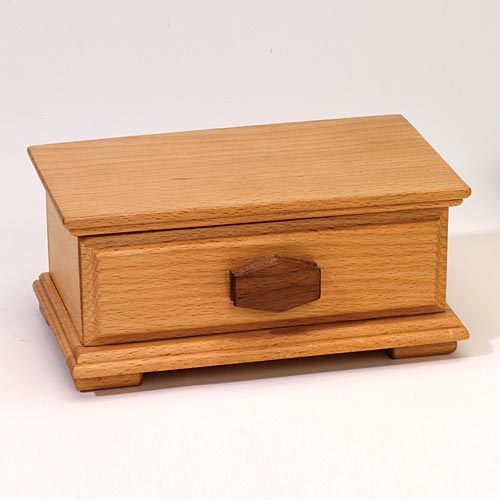
Of this order, I think Secret Drawer Box is my favorite. Bits and Pieces does not say who designed it in the description, which is a bit unusual. It has a nice appearance and a good finish. I tend to like the look of boxes with drawers, and the dark wood knob is cute.

The solution to Secret Drawer Box is not too tricky to find, but could take a few minutes or more. I think it only took me a minute or so, but it could take longer. The solution is fairly unique, but related in some ways to another box I have seen, which is likely why it didn't take me long to solve.

One downside to this puzzle is that you may accidentally open the box without knowing what you did! In that case, you'll find yourself unable to lock it, so now you have a new puzzle to deal with. This isn't a big problem as long as you are aware that this might happen. Definitely a good buy at $15, and it is on sale for $12 currently!

Confidential Keeper is another one that I liked. It is also just listed as 'exclusively designed for us', so I'm not sure who the designer is. The appearance of this one is also fairly good, with inlaid stripes going around the outside of the box. The first move is not well disguised in my version of the box, though it looks much better in the photo, so there is likely some variation.

Despite the first move being poorly hidden, the second move is quite well disguised! I think it took me a good 5-10 minutes to find the solution to this one. It required a bit more force than I would have liked the first time, but after that it loosened up a bit. I showed this to some non-puzzler friends and they also enjoyed it and most were able to solve it after a few minutes. At $15, I think this would also be a good one to pick up while it is available.

Two for two! Unfortunately the next one, Secret Sliding Box by Alan Boardman, was a bit of a dud. The first move is the same as Confidential Keeper (though better disguised), and that is all there is to it! That wouldn't be too bad, but that single move requires a lot of force, though I'm sure there is some variation across individual copies of this box.

On top of that, the hinge in the back is weak, so when I showed this box to some friends, they found that they could unlock the box simply by twisting the lid due to the loose hinge. They thought that this was the solution, which would be somewhat clever I suppose, but it will likely damage the box if done repeatedly. Don't bother with this one!

We continue to Original Kamei Telescoping Square Box, which has a really cool name. I was envisioning some interesting nested telescoping mechanism or something like that. The appearance of this one is not bad, it has light wood inlays in the corner which is a nice touch. I also like the rounding on the top. The base of the box is the same as Karakuri Small Box #4, #5, and #6, if you are familiar with those.

I worked on this one for a good 10-15 minutes before I started to think that I may have gotten a bad box. Fortunately, Kellian was there and was able to take a look at the solution. She said that she was surprised that I hadn't tried the solution already, and indeed it turned out to be something that I had tried! The box wasn't working properly.

Since I knew how the mechanism should work, I was able to devise a way to open it (using improvised tools) despite the fact that it wasn't working correctly. Unfortunately, this wasn't a long-term solution. I'm planning to let Bits and Pieces know that this box didn't work, and they'll probably issue some kind of credit on my account. They tend to be pretty good about these things, which makes the bad quality control somewhat more tolerable.

The actual solution is pretty good, though I'd recommend getting Karakuri Small Box #6 instead. The storage space is smaller, but the quality is way better.

That brings us to the final box of this batch, The Double Octagon Puzzle Box by Jean Claude Constantin. Unlike most puzzle boxes where the challenge is to open the box, the challenge of this one is to put it back together once you've opened it.

The metal screw on the top unscrews, the top lifts off, and the eight side panels fall out of place. Now your task is to put them back! Each plate has two tabs on each end, each of which can be skinny or fat. The lid and the base have holes in them with either tab fitting in the large hole and the small tabs fitting in the small holes.

The appearance of the box is OK, but not as good as other Bits and Pieces boxes. It is clearly laser cut and the finish is a bit rough, particularly on the side panels.

As a puzzle, I found it to be pretty good. You would think that it would be a lot of trial and error, but I was able to make some deductions based on the pieces that were available that sped up my search significantly. I think most will find this to be fairly difficult. It took me about 10-15 minutes to get it back together. Overall, not bad, but not really a standard puzzle box. If you like assembly puzzles like this, then I would recommend it.

In all, I was happy with the boxes I got in this order. I had a good time solving these boxes and will keep an eye out for more in the future.