August 29, 2011

2011 Rochester Puzzle Picnic (Part 3)

Even after a fairly late night puzzling, I couldn't help but wake up at 8:00 with more puzzles on the brain. Jeff had gone out and grabbed some fresh bagels, which were quite tasty! We sat around for a bit in his screened-in patio while munching on bagels.

After breakfast, Jeff gave us a tour of his shop, which had progressed nicely since I had seen it last year. You can see the pipes for his cyclonic dust collection system running along the ceiling. Pretty cool! Now if only he'd start making some puzzles!


In the morning we unpacked the many puzzles that folks brought. In this photo you can see Brett and Jeff looking through the full set of 2011 Puzzle Exchange puzzles that Tanya brought! A big thanks to Tanya for lugging all these puzzles so we could get a chance to try them out.

The first one I decided to check out was called Bunch by Teijo Holmsten. I hadn't taken note of it during the exchange for some reason, but it piqued my interest here when I noticed that it appeared to be a take-apart puzzle with a hidden mechanism of some sort.

It looks like four square sticks that have been glued together, one of which is made from a dark wood. It seems locked up pretty tight, but after a bit of investigation I was able to open it. It uses a fairly common principle in this type of puzzle, which is why it didn't take me that long. This may be a fun one to try out with non-puzzlers, but it may take them a while!

Ken Irvine brought 10 different 4x4x4 cube puzzles that he designed and built himself! Since he only had a mitre saw to work with, he just used the square sticks that he could purchase from his local home-improvement store, so the fit isn't perfect, but they worked surprisingly well! On top of that, they were fun and challenging designs.

The first one I tried was called The Nagging Wife, and I think it took me about 10-15 minutes to figure out how to put it together. It takes a few moves to get it apart, so you have to work your way backwards to figure out how to assemble it in the right sequence of steps.

Here's a photo of the pieces in case you'd like to try making this one out of LiveCubes. I encouraged Ken to send his designs to Ishino's Puzzle Will Be Played website so others could check out his designs. It is a site with tons of different puzzle designs cataloged, so in combination with a set of LiveCubes a puzzler can be kept busy for quite a while!

Jeff set himself to the task of solving all of the cubes Ken brought, and ended up making it through almost all of them! It is quite impressive that they kept his attention, since Jeff admittedly doesn't usually care much for this type of puzzle. I think I solved about 5 of them, and I had a good time doing so. Each provided a different challenge, but most can be done in a reasonable amount of time because it isn't too hard to deduce what the correct assembly is. Actually assembling them is the tricky part!

At one point over the weekend, Jeff made a bunch of perfectly square sticks for Ken, so we can look forward to seeing even nicer versions of these designs soon!

Next I decided to try V's in Cube, which was Ad van der Schagt's exchange puzzle. These are two separate puzzles that each consist of four pieces and a box. The goal is to assemble the pieces inside the box into a symmetrical shape. It looked a bit similar to MMMM by Iwahiro, which I liked a lot, so I was looking forward to trying this one out.

Unfortunately, the solution ended up being pretty much the same as MMMM, though the clear box gave a nice view of the assembled shape which looked pretty cool. Despite this, I didn't much care for the boxes since they disassembled into two C-shaped halves, each containing 3 sides, rather than the standard 5-sided box with a lid. This made it a bit of a dexterity challenge getting the assembled shape inside the box. (Update: George mentioned in the comments below that there are two additional challenges that I didn't notice, which may be more unique.)

Next, I made the mistake of picking up Magnet Mania exchanged by Christopher Morgan: this puzzle proceeded to vex me for the next hour! The goal is to assemble the nine spherical magnets into a 3x3 grid that was laser-cut into a piece of wood. There were little holes for the magnets, but they were just big enough to keep the magnets from rolling out of place. If another magnet got too close, they would snap together. There was a little tool with notches cut out of either end that ended up being pretty helpful too.

I tried again and again to get the magnets placed using various techniques, but each time they would snap together, driving me slightly closer to madness. I almost gave up a number of times, but Tanya and Tyler Somer (a friend and co-worker of Tanya's) egged me on and I knew I couldn't quit.

At one point I was convinced that it was impossible for a particular reason, but this observation eventually led me to the solution. I still need to check with Chris to make sure this observation was correct, maybe I just finally got the dexterity and order of the placements down, but I think I figured out something extra that I needed to do. It was still pretty tricky to do, so I didn't try doing it again. I was so happy to have finally solved this one, that I took a picture with this one solved!

After that bout with insanity, I decided to return to a type puzzle I'm more comfortable with: puzzle boxes! And this one was a doozie: a Rosewood Block Box by Kagen Schaefer! In case you're not familiar with Kagen, he makes some ridiculously cool, and very sought-after, puzzle boxes. Check out his website, but be careful not to drool on your keyboard.

Jeff was finally able to acquire this box from Kagen after a lengthy wait. It is a pretty neat idea: a combination of a sliding block puzzle and a secret box! You slide the rectangular pieces around trying to form the ebony pieces into circles. When this is done, the box will open!

I found this to be a bit more challenging than his Snake Box, which I tried at RPP last year, since there are more dead-ends. Still, it wasn't too tricky because the ebony pieces give you some direction. The original version of the box, Block Box, didn't have this feature. The original Block Box won both the Puzzler's Award and a First Prize award during the 2002 Puzzle Design Competition.

Even thought it was a bit tougher, I think I solved it in about 10-15 minutes. The pieces slid quite nicely, and I really liked the inclusion of some dead-ends to make it a bit trickier. You have to think ahead a little bit to figure out which way to go. One thing that seemed a bit off was the light-colored wood in the left hand side of the frame: some folks might like this unusual feature of the wood, but I would have preferred it to be more uniform. Still, a beautiful puzzle that I'm thrilled to have had the chance to try!

Well that's all for this post, but I'll pick back up with a few more interesting exchange puzzles tomorrow, and a very nice puzzle box that I managed to overlook on Friday.

August 25, 2011

2011 Rochester Puzzle Picnic (Part 2)

When I left off in my post yesterday, I had arrived at Jeff's house and was proceeding to work my way some of his new puzzles!  Next, I decided to give some of the new series of nature-themed Karakuri boxes a try.

The first one that I tried is called Little Tree. It is a nice little square box with a tree on the top. The tree is made from colored woods, which I thought looked nice. As a puzzle, most will find this to be pretty trivial, so I am OK with not having purchased this one, even though it is pretty reasonably priced at $46. Jeff Chiou wrote a blog entry about this puzzle where he notes that the fit is so loose that the puzzle practically solves itself. While I didn't have this problem, a few other people at the party did.

Next up was a box called Mother Tree. This box is about twice as large as Little Tree, and has a more complex design on the top. It is similarly made out of wood that is raised a bit from the surface. Again, this one is quite simple and most will solve it in well under a minute, but I liked the mechanism on this one a bit more because the drawer pops out. That's always a fun little surprise! This one must be a bit more complex to make, since it is significantly more expensive than Little Tree at $137.

Finally, we have Star Night, which is a bit different from the other two: it has a polar bear walking across an icy tundra under a starry night sky. Some folks may not like the "stars" since they're plastic (or glass?), but I think it adds a nice little sparkle to the scene.

You'll quickly notice that the polar bear is held on magnetically, as you may expect. The solution to this one isn't too difficult, but is a bit harder than the previous two. The mechanism is a bit more interesting, so I think this is probably my favorite of the three. Like Mother Tree, Star Night is priced at $137. All three boxes are available for sale now at the Karakuri Creation Group website.

This next puzzle is by Fumio Tsuburai and named Karakuri Yohkan. Yohkan is a type of Japanese dessert that consists of bean jam and gelatin. Tasty! It has a pretty unusual appearance as you can see: there is a wooden sleeve that encloses a speckled brown package.

This box was pretty easy to open, a bit of  fiddling quickly led me to the solution, though perhaps I just got lucky. It is a somewhat unique movement, but I didn't find it to be particularly interesting. It had a bit of a lightweight feel to it, which made me a bit worried about the durability of the mechanism.

Next I tried Cube KW2 by Hideaki Kawashima, which looks a lot like the Karakuri Cube Box series (see this blog post), only it is a bit larger and has less of a bevel on the pieces. Kawashima describes it as a deluxe edition of the cube series, and I agree that it goes beyond any of the cube puzzles in terms of complexity.

This box actually has two small storage compartments, each which are accessed by similar movements. I found this one to be moderately challenging, due to the way it is constructed there are a lot of options for the way it can move. After finding the first bit, it took me a little longer to actually finish opening it. It does a nice job of using your assumptions against you, though at its core it is a fairly common trick. I really enjoyed this one!

While I was working my way through these puzzles, Tanya Thompson from Think Fun arrived, and she brought with her all of the 2011 puzzle exchange puzzles! We all stayed up pretty late working on puzzles, I think I got to bed around 2:30 or so. I hoped I wouldn't be too tired to work on some more puzzles on Saturday!

August 24, 2011

2011 Rochester Puzzle Picnic (Part 1)

Two weeks after the International Puzzle Party, Jeff Aurand hosted the second annual Rochester Puzzle Picnic! You may think that it's odd that it is so close to the IPP, but that was by design: the idea is to give everybody a chance to get together after the IPP and share the puzzles they got. This is also a good chance for folks who didn't make it to see some of the new puzzles that were released at the IPP.

I headed up on Friday, and made it there after a fairly grueling 8 hour drive. There was a vehicle on fire that blocked the highway for a bit, which is why it took longer than usual!

When I got there, only Jim Strayer had arrived so far. Jeff, Jim and I had a bit of pizza while we started working on puzzles. The first one I decided to try was Rainer Popp's T5 Popplock, since I have really enjoyed the other Popplocks that I had tried (T3 and T4).

The T5 Popplock is good and solid, like the T4 in terms of weight. It comes with a key, and has an odd looking mechanism on the front. I really liked the circular "bullring" shackle on this lock, it sets it apart from the usual U-shaped shackle. This may leave you wondering a bit how it may open.

In terms of difficulty, I found this one only moderately difficult: it took me about 20-30 minutes to solve. It was easier than T4 and about the same as T3 for me. There are two distinct stages to the solving process, both of which I found to be equally challenging. The first stage is good, but what I really liked about this one was the second stage.

Overall, I really liked the T5 Popplock, I can't really think of any negatives other than its fairly high cost. It is currently one of my favorites in the series, along with T4.

Later in the weekend, I tried T2 Popplock, but I figured that I should talk about it now since I just mentioned the T4. I forgot to take a picture, so this picture is from Oli's blog: check out his review of the T2 Popplock.

The T2 Popplock is a bit thinner than the T5, but still quite substantial. It comes with a key with an odd pointy thing coming out of the handle. Like all of the Popplocks, it is beautifully machined.

I found the T2 Popplock to be more difficult that the T5, but not quite as hard as the T4, which took me a few days. I think this one took me around an hour to solve across a few puzzling sessions. The first step probably won't elude people for very long, though it did actually take me a little while. After that, it gets quite a bit more complicated, since there is a lot going on with this lock. I had a fairly good idea of how it worked, but I couldn't quite get it to open.

At one point, Jim mentioned that it took a fair bit of force to actually pull open the shackle even when it is unlocked. This helped me quite a bit, since I had just been applying a bit of pressure with the top of my index finger as I fiddled with the lock. With this in mind, I was able to open the lock a few minutes later. Thanks Jim! I don't really consider that a spoiler, but just a tip to keep you from wasting too much time once you've already practically solved it, but let me know if you feel differently.

Next up, I tried an interesting-looking puzzle box by Hiroshi Iwahara. It is named Chiyo-Musubi after the name for a knot made in a belt or paper tape. It is a fairly large box at almost 10 inches long. The craftsmanship is quite nice, as you would expect, though Jeff pointed out a spot where the red wood bled a bit into the light-colored wood, which is unfortunate.

As a puzzle it was not particularly challenging, but still pretty fun to solve. It takes 19 moves to open it completely, and the moves follow a pretty logical progression. I got stuck at one spot, but it was just because one of the panels was a bit hard to slide. It is a nice box and probably worth the price ($540 for Karakuri members before it sold out) in terms of craftsmanship with all the odd angles, but I'd prefer something that would keep me busy for a bit longer if I'm going to spend that much on a puzzle.

This next puzzle is one that Jim suggested I try: it is called Letter from Forest by Yukio Ogura. It looks a bit plain from the outside, though there is a design on the top that I didn't much care for. It looked a bit more like paint than an inlay, but it was hard to tell.

It was an interesting box with an unusual movement, which is always fun to see. After the first bit, there is an interesting little surprise that progresses to finally opening the box. That next step isn't particularly difficult, but fun. Overall, a nice box! It is currently for sale on the Karakuri Creation Group website.

Well it is getting a bit late, so I'll have to pick up with this tomorrow! Plenty more to come!

August 23, 2011

2011 Puzzle Design Competition (Part 4)

This is the fourth and last post in my series reviewing the puzzles in the 2011 Puzzle Design Competition.

Snake Cube by Hideaki Kawashima


This is another 2010 Karakuri Club Christmas Present that I already own. Check out the full review here, I really enjoyed it! I thought this one would win something, since it has a nice movement with an interesting pattern, but I guess there were a bunch of other good puzzles this year, too!

Spin by Tom Lee


I unfortunately didn't have time to attempt this one. Like I've mentioned before, I'm not particularly good at string disentanglements, and it looked like this one would take me a while. I'll have to practice up on them before IPP32 so I can get through more of these next year.

Spinnomotto by Stephen Chin


This is another interesting and unique puzzle by Stephen Chin. The goal is to open the box and find the small top inside. He used a woodworking process called segmented wood turning to create the pattern on the barrel. In this process, segments of wood are layer up and glued together to make a decorative pattern. Very neat!

The top of the barrel has a plastic covering, through which you can see a hole and a metal ball. You can't quite get the metal ball into the hole because of a lip around the hole. There is also a top that is part of the puzzle. There are a few steps to this puzzle, I found the beginning pretty easy, but the ending is a bit tougher with a nice little surprise. It also contains a bit of electronics that plays a little tune when you solve it, which is cute.

Spiral-n by Dimitar Vakarelov


Unfortunately this is another set of string puzzles I didn't get a chance to solve. Similar to Fan-2n, techniques for Spiral 2 are used to solve Spiral 4. It looks tricky!


Spots by Steve Kemp

The goal of this puzzle is to put the magnetic tiles on each face of the cube, so that the numbers 1-6 are represented by the dots. Unlike a standard die, the spots are not oriented symmetrically, which makes it a good deal harder!

I played around with this one briefly, but it seemed like ti was going to take quite a while considering how many pieces there were (48). Perhaps there is a clever way to do it in a reasonable amount of time, but I didn't discover it during the short time I worked on it.

Tea Time by Victor Lam and Kazakh Wong


This is a cute little puzzle that consists of a beautifully turned teacup and saucer, with a spoon stuck through the handle of the teacup. The spoon is held in place by a cube (sugar cube?) and string, and the goal is to remove them. The teacup is quite thin, which is impressive, but it made me a bit afraid that I was going to damage it.

As a puzzle, it was fairly easy, even with the flexible component that usually causes me trouble. One annoying thing was getting the string back through the cube, the hole was a bit too small to do it easily so I had to kind of twist up the string and feed it through like I was threading a needle.

Three-Cornered Deadlock by Hideaki Kawashima

This is another puzzle box by Kawashima, and the goal is to open all three boxes at the same time. It looks a bit like three Snake Cubes stuck together, and is quite large. The movements are similar to Snake Cube, but not exactly the same. I started out and was able to open one of the boxes fairly easily, and I hoped that there was a clever way to simultaneously open all three boxes. Unfortunately, you just need to leave the lid off of the first box, then backtrack and do the second box. This feels a bit repetitious, I wish there was something new added in there along the way.

Tick Box by Sam Cornwell


This is a bit of a variation on a sliding-block puzzle, the goal is to disassemble and reassemble it. At first, it seems like nothing will move, which is a bit surprising for a puzzle of this type. It turns out that there is something sneaky going on with this one!  It took me about 3 minutes to solve, but I wasn't quite sure what I had done until it fell apart. Once it was apart, I could see what was going on.

TriPenTile by Péter Gál


The goal of this puzzle is to assemble the pieces to fill in the holes. There are additional problems in the booklet too. As you may be aware, regular pentagons cannot tile a plane, so while these pentagons have sides that are the same length, the angles have been tweaked to allow them to tile properly without gaps.

I worked on the bottom problem for a good 10-20 minutes, but didn't have any luck. The geometry is very confusing, so it took a lot of trial and error to figure out what piece would fit where. Contrast this with pentomino packing where you can tell visually what is possible quite easily. This makes for an interesting challenge above the usual tray packing puzzles. I also liked the book format, it packs up nicely to bring with you.

Triple Mosaic by Wim Zwaan


The goal of this puzzle is to make a mosaic with 9, 6, or 4 black squares. The pieces are all tetrominoes (like Tetris), though there is no square piece. There are four L's, two I's, two T's, and one S. The pieces are all nicely crafted from solid wenge and maple, so they can be flipped over, which makes it even more tricky.

I spent a little while trying to make the 9-square mosaic, and didn't have much luck. I could get it mostly done, but always had the odd piece or two that wouldn't fit. I really liked this one, because it gives you a bit of a starting point for your packing, since the colors need to match up properly. This reduces the search space somewhat, so you don't need to try every piece that fits, only the ones that will continue your coloring. Still, I found it pretty tough and couldn't complete it in the 10 or so minutes I spent on this one.

Twelve Piece Burr Ball by George Miller


The goal of this puzzle is to disassemble and re-assemble the burr. Each piece is a half-circle that is notched on the inside and outside of the curve in five different spots. By aligning the notches, the ball below can be constructed. I started to take the first piece out of this one, but quickly realized that it would become a bit of a mess so I decided to leave it alone. It seems like it would take quite a bit of trial and error to figure out the arrangement of the pieces, and it would be quite challenging with this unusual geometry. George notes that the flexibility of the wood is necessary to get the first piece out, which made me a bit nervous.

Twisted-8 by David Pitcher


This is another baffling twisty puzzle that I didn't attempt. The designer notes that it turns on 10 different axes: the eight axes around the equator turn 180 degrees and the two axes at the four-sided vertexes can turn in 45 degree increments, allowing for shape-shifting.

Wandering Chain - Three Rings by Ede Gergényi


This is another interesting looking chain disentanglement puzzle, and I wasn't optimistic about being able to figure it out during the time I had. The geometry of it is pretty confusing, with the three rings linked together in an interesting way. I think I spent a good 10-20 minutes on this one, but didn't have any luck solving it. It does have a nice visual appeal, it doesn't leave your eye a place to rest.

WAY by Volker Latussek


This is an interesting construction puzzle where the goal is to build free-standing circuits. Free-standing in the sense that they won't fall over, and circuit in the sense that it is one big loop of pipe. One thing that wasn't clear from those instructions is that you can build up off the table, you're not restricted to building the circuit flat.

I liked the way that this puzzle had a number of different challenges of increasing difficulty: you could start out by trying to build with 2 L's, 2C's, and 1 S and move up from there. I found this beginning challenge to be pretty tricky, since adding that third dimension makes things a bit more complicated.

I'm not sure whether it would change the puzzle at all, but it would have been nice of the pieces linked together somehow to make the structure more stable. Or perhaps had flat spots so they didn't roll around quite as much. Still, it was an interesting and fun challenge.

You can purchase this puzzle or find more information here.

Xmatrix Cubus by Jeremy Goode


The goal of this puzzle is to navigate the ball from the gold frame to the silver frame and back again. I'm not a huge fan of this type of puzzle, but it is very nice looking and fairly challenging to solve. I spent a little while wandering around in the maze, but didn't have much luck with it. Due to the way the maze is constructed, it is a bit challenging to see what the path looks like, though I guess that's the point! You can purchase it here.

Zen by Carbriel Lai


Finally, we have Zen which is another flexible string disentanglement puzzle, and has the unusual component of a laser-cut acrylic frame. Personally, I prefer the classic bent-wire look, but this sure does look different! Again, I didn't have any luck solving this one.


Well that's all! I hope you've enjoyed this series of posts about the design competition puzzles. I'm already looking forward to next year!

Here are links to the whole series of posts in case you missed something:

Berlin Awards Banquet (Part 1) - Top 10 Vote Getters
Berlin Awards Banquet (Part 2) - Award Winners
2011 Puzzle Design Competition (Part 1)
2011 Puzzle Design Competition (Part 2)
2011 Puzzle Design Competition (Part 3)
2011 Puzzle Design Competition (Part 4)

August 19, 2011

2011 Puzzle Design Competition (Part 3)

This is part three in my series of posts reviewing the puzzles in the 2011 Puzzle Design Competition.

Ice-9 by David Pitcher

This twisty puzzle has an unusual shape, and can be turned on six different axes: the three axes going through the four-sided vertexes can be turned in increments of 90 degrees, and the three axes going through the diamond-shaped faces can be turned 180 degrees. I fiddled with this one a bit just to see how it turned, but I didn't spend any time trying to solve it.

Kernel by Sam Cornwell

The goal of this puzzle is to take it apart and re-assemble it. Unfortunately, I didn't get a chance to try this one, I'm not quite sure how I missed trying it. I saw a few people working on it, and it looked like it was fairly challenging but doable. I like the symmetry and appearance of this one.

Knot for You by Mineyuki Uyematsu (Mine)

This puzzle will disassemble into four pieces: two beads, a ring, and the string with walnuts on the end. I thought the walnuts were a nice touch, Mine could have have just used beads, but this gave it a different look from your standard disentanglement puzzle. I spent a good 20-30 minutes working on this one, and wasn't having much luck, but eventually I figured it out. These string disentanglements are tricky!

Lost L by Kohfuh Satoh

This puzzle looks like a puzzle I had seen before where the goal is to make the letter E, so I tried that trick and didn't have much luck. I came up with a rather silly solution, and when I looked on the back, that was what was written! I think there is probably a more elegant solution though, since it said the solution is not unique, but I'm not sure!

Magic Domino by W.G.H. Strijbos

This puzzle is a bit complicated to understand, but it is a cool idea. It works on the same "vanishing" principle as The Vanishing Leprechauns Puzzle, but with the added fun of a sliding puzzle. First, you take the eight light dominoes out and rearrange the pieces so you can fit the seven dark dominoes where the eight light dominoes were. (there are two panels that move, like the Leprechaun puzzle). Finally, take out the spacer and slide the 11 squares around until you can fit the 8 white dominoes in the holes and return the spacer to its original position.

Like I said, a bit complicated but a cool idea in theory. After appreciating it for a bit, I didn't spend any time solving this one, since presumably it is just a matter of matching up the correct top piece with the right bottom piece, and I figured that would take a while and not be particularly rewarding. Then it is just a matter of solving the sliding puzzle to get the pairs you identified matched up. Pretty neat!

Moscow Ball by Dmitry Pevnitskiy and Sergey Grigoriev

I really liked the look of this puzzle: the rounded shape is a really nice touch and I liked the colors of the woods. Fiddling with it briefly, you'll quickly realize it is a 4-piece coordinate motion puzzle. The motion is quite nice with the whole puzzle expanding outwards. I didn't find it particularly challenging to take apart or put back together, but it is still a fun and nice-looking puzzle.

Pack Berlin by Abel Garcia

This is another one that I unfortunately did not have the time to properly solve. I played around with it a bit, but only enough to appreciate the nice craftsmanship. The pieces were nice and smooth, and fit well in the box. I really liked the choice of wood used for the pieces!

The designer notes: "This puzzle was designed with three goals in mind: all pieces of the same thickness, unique solution, and difficult or impossible to solve using puzzle-solving computer software. The puzzle incorporates the 'missing area' principle into a 3-D box-packing puzzle."

Puzzle Gift Box by Allen Lin

I was quite curious about this one, since I couldn't identify who made it. It is a rather innocuous looking box, so it could be hiding any manner of surprises. I solved it in about 5-10 minutes, it is fairly tricky but uses some fairly common tricks in secret-opening puzzles, so I didn't find it all that interesting. Hopefully Allen will continue designing boxes, I look forward to seeing what else he comes up with!

Quadratum Cubicum by Christian Blanvillain


This is another puzzle that I didn't really spend any time with. It has 68 pieces which is just mind-boggling! Of these pieces, you can select a subset that can be formed into either three small squares (simultaneously) or one large square. There are nine subsets with this property. The large squares can then be stacked to form a cube. Phew! That sounds like a lot of work! Here's a link to a paper with more information about the history of these dissections.

RAT by Kohno Ichiro


This is a cute little puzzle where the pieces spell out the word RAT, and you can also use them to construct a rat! As you may expect, since there aren't many pieces, this isn't particularly challenging. I solved it in only a minute or so. Still, a cute idea! It may be fun to do a series of these for children.

Ring Case by Osanori Yamamoto


The goal of this puzzle is to assemble the four pieces inside the frame such that none of them sticks out. It is nicely crafted and I liked how all four pieces are identical. Unfortunately, I didn't get around to solving this one! I'll have to try building it out of LiveCubes at some point, since it looks like fun.

riZidity by Bram Cohen


This is another design where the goal is to put the pieces in the box in such a way so they don't rattle around if you shake the box. I was able to figure out fairly quickly what the structure inside should look like, but I had a hell of a time actually constructing it! I must have spent a good 45 minutes on this one. I gradually built it up, and then it collapsed. This happened a bunch of times, but I was determined to solve it. Eventually I did get it! It was quite satisfying, so I took a picture, but I can't post it here since then you'll see the solution!

Despite spending a fair amount of time on it, I don't think I liked this puzzle much since it was more of a dexterity challenge than anything. Even when you got the structure together, I found that it was highly unstable. I think perhaps making it out of a different material would have helped, or making it larger (though it was already quite large). Also, the joints on the box were a bit spiky and poked my hand as I tried to put the pieces inside, so that wasn't so great as well. Still, an interesting geometric construction that I wouldn't have thought of!

S in Bloom by Gregory Benedetti


The goal of this puzzle is to use the eight dark pieces to make an S inside the frame. I fiddled around with this one for a bit, but didn't have much luck. I have a tough time with these more abstract puzzles where you don't know quite what you're supposed to be doing. Eventually I gave up and looked at the solution, and it is pretty good! Perhaps I would have gotten it if I stuck with it a bit longer: it is tricky but not impossible.

Shift Pole by Albert Gübeli


This is an interesting variation on a twisty puzzle where the faces are held onto the core by magnets. You then use the two clear shells to rotate the pieces in a number of ways. I tried to play around with this one just to see how it worked, but unfortunately one of the shells had broken. It doesn't really work without the shells since the pieces fall apart in your hands. Oh well! It is a clever idea!

Simple Solid Ring Maze by Yuta Akira


I was suspicious about this puzzle since usually a puzzle claiming to be simple is anything but! So I suspected that some amount of random fiddling would lead to the conclusion that the puzzle was impossible, but then there would be a sneaky trick to make it possible. All this speculation was for naught: it is actually just as it appears, a split ring puzzle with a notched cage. You just have to navigate a maze to get the ring to the exit position. I spent a minute or so on this one before figuring it out, it actually was pretty simple!

Sliding Put Together Puzzle by Ton Delsing


This is another interesting variation on the a sliding puzzle. Similar to Magic Domino, the goal is a bit complex: "Put the 15 pieces in the tray to construct the digits 1 through 9 in numerical order. Then slide the pieces to form a magic square (you must first determine how this magic square can be constructed)." I tried the first part, which is just to assemble the digits 1 through 9, and had a hell of a time doing that. The pieces are digits look pretty unusual, and each spans multiple tiles. Also, there is a black border around the puzzle which obscures the edges, so you can't even use the strategy of starting in a corner very effectively. Very tricky!


Ok, that's all for now! I should be able to wrap it up tomorrow, so stay tuned for the final installment!


August 18, 2011

2011 Puzzle Design Competition (Part 2)

This is part two in my series of posts reviewing the puzzles in the 2011 Puzzle Design Competition.

Daedalus by Gregory Benedetti


The goal of this puzzle is to take apart and re-assemble the cube. This process is made quite difficult by pins on the pieces that slide along corresponding grooves. That would be difficult enough, but there are also rotational moves! This is a very nicely crafted puzzle, I really liked the choice of wood used.

I found this one to be way too difficult, it was really hard to tell what was going on since I found the puzzle in a partially solved state. It was hard to tell what was supposed to go where, and it was even difficult to tell where the exit would be for the first piece! The solution diagram didn't have the locations of the pins, so that didn't even help. I think if I got this puzzle in the solved state and could gradually work on taking it apart, it may be doable, but given the time constraints I was quite overwhelmed by this one!

Diamond in the Frame by Kirill Grebnev, Alexei Kanel-Belov


This puzzle has two goals: to take six cubes with magnets and one cube without magnets to create a single, interlocking, symmetric figure and take 12 cubes with magnets and seven cubes without to create a single, interlocking, symmetric figure. Some of the cubes have magnets in the corners, which helps them attached to each other in various ways. Unfortunately, by the time I started playing with this one, some of the magnets had started to come loose, so I can't really evaluate this one.

Dino Cylinder Cube by Li Chung Ma

I'm no expert in twisty puzzles, but the description says that it is a Dino Cube that jumbles due to the cylinder shape. I didn't really spend any time playing with this one, so I'm not sure how difficult it is. It looks nice though!

Dog Head by Diniar Namdarian


This is a classic silhouette puzzle where the goal is to make a shepherd's dog head by combining the other five pictures. Unfortunately, I didn't get a chance to try this one, but I did like the fact that each of the panels is a different image.

Double Gear & Wheels by Namick Salakhov

The goal of this puzzle is to remove the gear that is trapped between the two wheels. There is an axle that runs through the two wheels, but it has a gap in the middle. However, the gap is only wide enough to run along a movable track that is on the gears. The gear also has features near the teeth that interact with the posts along the outside of the wheels.

I tried this one for a bit and found it quite difficult. It was hard to tell what was a legal move, since there is a lot going on. I found that I was able to tilt the gear up and down a bit, but it had a tendency to jam up. I think it is a good concept, but a bit complex for my taste. Perhaps if it was simplified a bit, it would have worked a bit better.

Equal7 by Vladimir Krasnoukhov


The goal of this puzzle is to arrange the dice so that on each face the number of dots is seven. There is one missing die from the 2x2x2 cube, so you can slide the others around with gravity. The top corner in the photo is permanently painted, so that gives you a starting point for solving the puzzle. It has some protrusions that are built into the puzzle so it stands on its corner as shown.

I worked on this one for a bit, but didn't have much luck with it. I have a fairly crummy memory, so have trouble remembering which faces are hidden when you can't see them. Perhaps I could have gotten the hang of it if I had tried for longer, but I didn't have a chance to return to this one.

Fan-2n by Dimitar Vakarelov

This is a series of disentanglement puzzles where the goal is to remove the string. Shown here are Fan-2, Fan-6, and Fan-4. The idea is that the solution you find in Fan-2 can be applied recursively to Fan-4 and Fan-6, but I had trouble even solving Fan-2! I'm no good at these disentanglement puzzles, I really need to work on them more!

Flemin' by Shiro Tajima

I actually solved this puzzle ago at Jeff Aurand's house, but I had absolutely no luck with this copy! I think it may have been stuck or something, since I didn't see anybody else open it. The instructions were a bit unclear, so maybe it is just really difficult, but I doubt that. Ah well! From what I remember, however, it is a very cool box!

Four to Square by Jacques Haubrich

This is a cute little 4-piece tray packing puzzle. It seems like it would be simple, but I had a heck of a time solving it! I worked on it for a good 20-30 minutes and didn't have any luck. The pieces are all oddly shaped, with corners missing and whatnot, which adds to the challenge. I liked the construction, it is made out of stainless steel so has a great weight and feel to it.

Granny's Tea Box - Granny's Hammer by Kelly Snache


I was quite interested to try this box out, since I already have one of Snache's other tea boxes (a different design). I love how he is re-using these old tea boxes, though of course since they weren't originally designed to be puzzles, the lid has a bit of play.

This one took me about 5-10 minutes to "solve", but I wasn't quite sure what I had done. Once I had it open, you can actually see the whole mechanism and disassemble it, which is pretty neat. However, I don't really like puzzles that have multiple hidden moves without any clues to help you out. It is just too easy to solve randomly, then you don't really have the satisfaction of having figured it out.

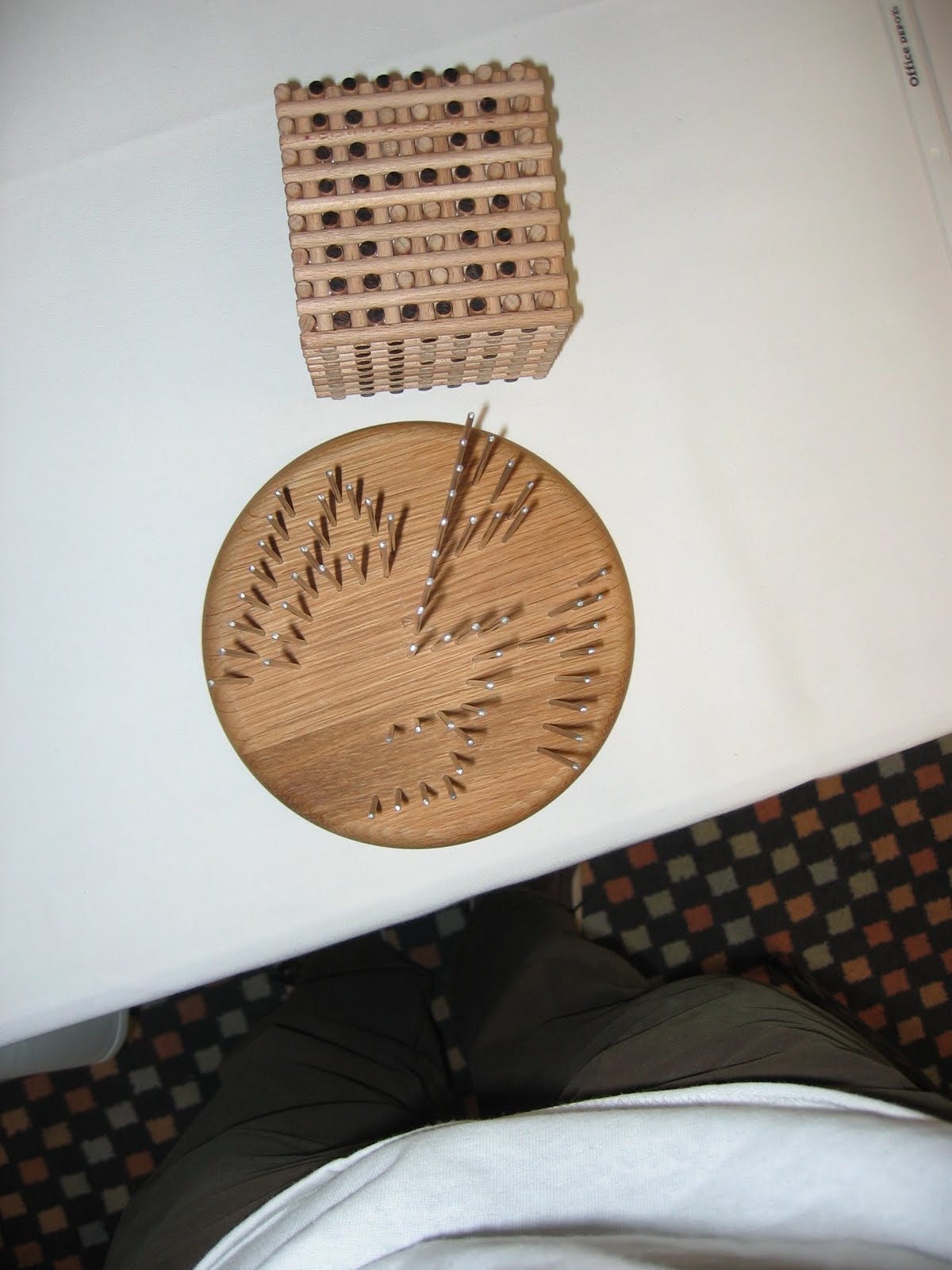
Grid Sticks Cube 8 by Sándor Bozóki

When I first saw this puzzle, I thought it was just a large matchstick cube, where it was supposed to be some sort of impossible object or something. I was wrong! It actually consists of 8 pieces that consist of a bunch of sticks that have been pinned together. Some of the sticks have their ends colored black. The puzzle is to re-assemble the cube such that the faces of the cube read BERLIN.

I was reluctant to take this one apart, but fortunately somebody else did the dirty work for me so I set myself to the task of putting it back together. Getting it back into a cube wasn't particularly challenging, it just took a bit of trial and error. Getting the faces to read BERLIN was a bit harder, and took me probably another 20-30 minutes. I did have a good time doing it though!

As I was putting it back on the stand, I wondered why the pins were arranged so randomly. Upon closer inspection, I noticed that they read IPP 31 from the top! Isn't that cool? It was hard to see, so I'll bet most folk missed out on that little tidbit.

Groove Cube by Eitan Cher


This was a really unusual variation on a 2x2x2 Rubik's cube: rather than try to have the each face be a solid color, you need to arrange the cube so it will fit into the grooved yellow box. Each face has a different series of bumps on it, so you need to figure out how to arrange the bumps and then solve the cube to get the bumps in the correct position.

I figured it would take a while to deduce what the correct bump arrangement must be, so I didn't end up solving this one. It is a clever idea though!

Horrible Hexagon by Ton Delsing

It may look like a simple 3x3 sliding puzzle, but, true to it's name, it is tough! You can only get to the middle square by coming from either the top or the bottom, and there is a piece inside that only allows you to exit the direction you entered. For example, if you slid up from the bottom into the middle, the only way to get back out is to slide back down to the bottom, the way up is blocked.

This makes what would be a fairly simple puzzle into one that is more challenging. It seems like it should be doable if you spend some time figuring out ways to permute the pieces, but I didn't have much luck in the time I spent on it. I think I tried it for a good 20-30 minutes but was only able to assemble a small portion of the image.


Well that's it for today! More to come in Part 3 tomorrow!