August 18, 2011

2011 Puzzle Design Competition (Part 2)

This is part two in my series of posts reviewing the puzzles in the 2011 Puzzle Design Competition.

Daedalus by Gregory Benedetti


The goal of this puzzle is to take apart and re-assemble the cube. This process is made quite difficult by pins on the pieces that slide along corresponding grooves. That would be difficult enough, but there are also rotational moves! This is a very nicely crafted puzzle, I really liked the choice of wood used.

I found this one to be way too difficult, it was really hard to tell what was going on since I found the puzzle in a partially solved state. It was hard to tell what was supposed to go where, and it was even difficult to tell where the exit would be for the first piece! The solution diagram didn't have the locations of the pins, so that didn't even help. I think if I got this puzzle in the solved state and could gradually work on taking it apart, it may be doable, but given the time constraints I was quite overwhelmed by this one!

Diamond in the Frame by Kirill Grebnev, Alexei Kanel-Belov


This puzzle has two goals: to take six cubes with magnets and one cube without magnets to create a single, interlocking, symmetric figure and take 12 cubes with magnets and seven cubes without to create a single, interlocking, symmetric figure. Some of the cubes have magnets in the corners, which helps them attached to each other in various ways. Unfortunately, by the time I started playing with this one, some of the magnets had started to come loose, so I can't really evaluate this one.

Dino Cylinder Cube by Li Chung Ma

I'm no expert in twisty puzzles, but the description says that it is a Dino Cube that jumbles due to the cylinder shape. I didn't really spend any time playing with this one, so I'm not sure how difficult it is. It looks nice though!

Dog Head by Diniar Namdarian


This is a classic silhouette puzzle where the goal is to make a shepherd's dog head by combining the other five pictures. Unfortunately, I didn't get a chance to try this one, but I did like the fact that each of the panels is a different image.

Double Gear & Wheels by Namick Salakhov

The goal of this puzzle is to remove the gear that is trapped between the two wheels. There is an axle that runs through the two wheels, but it has a gap in the middle. However, the gap is only wide enough to run along a movable track that is on the gears. The gear also has features near the teeth that interact with the posts along the outside of the wheels.

I tried this one for a bit and found it quite difficult. It was hard to tell what was a legal move, since there is a lot going on. I found that I was able to tilt the gear up and down a bit, but it had a tendency to jam up. I think it is a good concept, but a bit complex for my taste. Perhaps if it was simplified a bit, it would have worked a bit better.

Equal7 by Vladimir Krasnoukhov


The goal of this puzzle is to arrange the dice so that on each face the number of dots is seven. There is one missing die from the 2x2x2 cube, so you can slide the others around with gravity. The top corner in the photo is permanently painted, so that gives you a starting point for solving the puzzle. It has some protrusions that are built into the puzzle so it stands on its corner as shown.

I worked on this one for a bit, but didn't have much luck with it. I have a fairly crummy memory, so have trouble remembering which faces are hidden when you can't see them. Perhaps I could have gotten the hang of it if I had tried for longer, but I didn't have a chance to return to this one.

Fan-2n by Dimitar Vakarelov

This is a series of disentanglement puzzles where the goal is to remove the string. Shown here are Fan-2, Fan-6, and Fan-4. The idea is that the solution you find in Fan-2 can be applied recursively to Fan-4 and Fan-6, but I had trouble even solving Fan-2! I'm no good at these disentanglement puzzles, I really need to work on them more!

Flemin' by Shiro Tajima

I actually solved this puzzle ago at Jeff Aurand's house, but I had absolutely no luck with this copy! I think it may have been stuck or something, since I didn't see anybody else open it. The instructions were a bit unclear, so maybe it is just really difficult, but I doubt that. Ah well! From what I remember, however, it is a very cool box!

Four to Square by Jacques Haubrich

This is a cute little 4-piece tray packing puzzle. It seems like it would be simple, but I had a heck of a time solving it! I worked on it for a good 20-30 minutes and didn't have any luck. The pieces are all oddly shaped, with corners missing and whatnot, which adds to the challenge. I liked the construction, it is made out of stainless steel so has a great weight and feel to it.

Granny's Tea Box - Granny's Hammer by Kelly Snache


I was quite interested to try this box out, since I already have one of Snache's other tea boxes (a different design). I love how he is re-using these old tea boxes, though of course since they weren't originally designed to be puzzles, the lid has a bit of play.

This one took me about 5-10 minutes to "solve", but I wasn't quite sure what I had done. Once I had it open, you can actually see the whole mechanism and disassemble it, which is pretty neat. However, I don't really like puzzles that have multiple hidden moves without any clues to help you out. It is just too easy to solve randomly, then you don't really have the satisfaction of having figured it out.

Grid Sticks Cube 8 by Sándor Bozóki

When I first saw this puzzle, I thought it was just a large matchstick cube, where it was supposed to be some sort of impossible object or something. I was wrong! It actually consists of 8 pieces that consist of a bunch of sticks that have been pinned together. Some of the sticks have their ends colored black. The puzzle is to re-assemble the cube such that the faces of the cube read BERLIN.
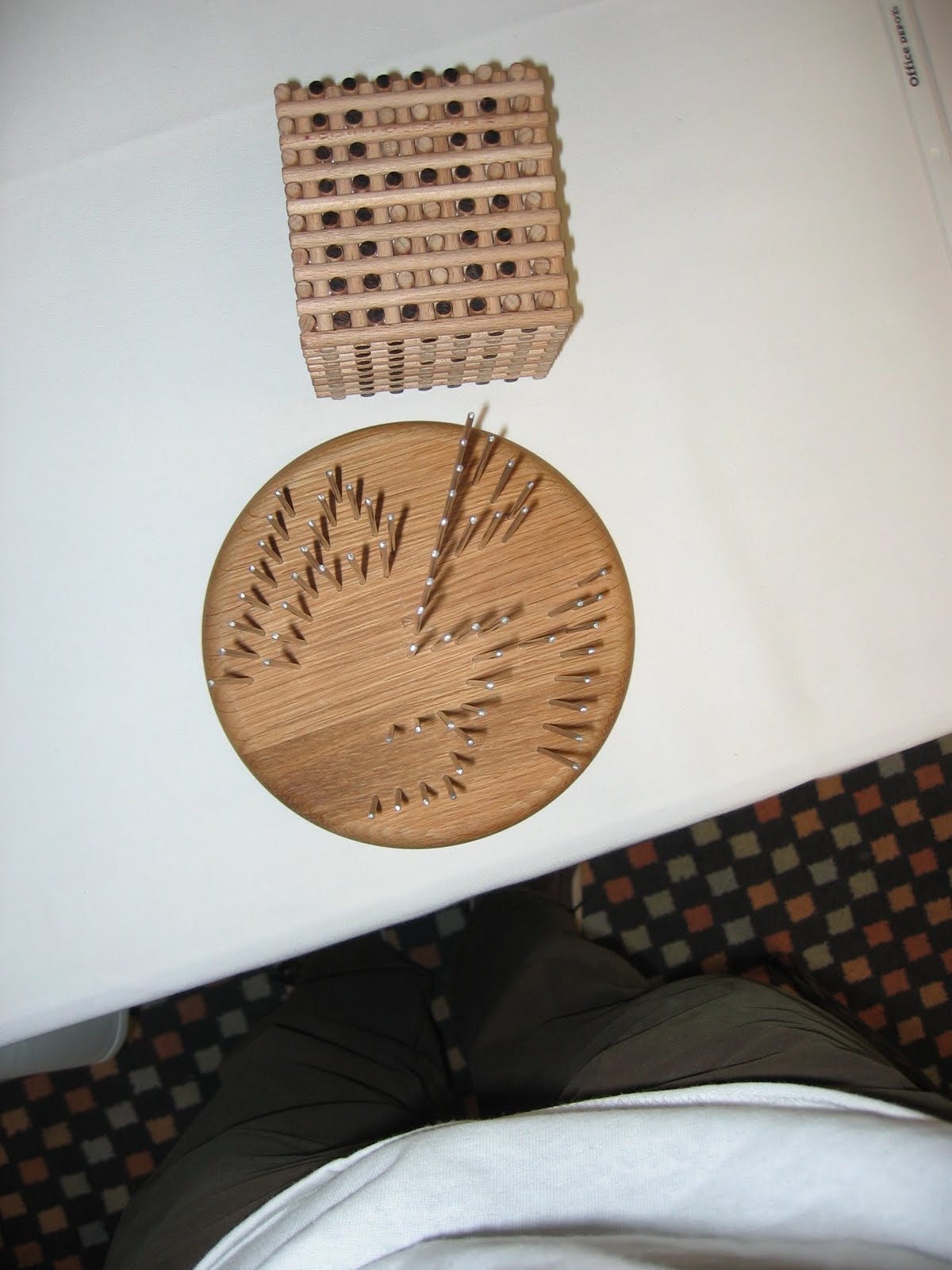
I was reluctant to take this one apart, but fortunately somebody else did the dirty work for me so I set myself to the task of putting it back together. Getting it back into a cube wasn't particularly challenging, it just took a bit of trial and error. Getting the faces to read BERLIN was a bit harder, and took me probably another 20-30 minutes. I did have a good time doing it though!

As I was putting it back on the stand, I wondered why the pins were arranged so randomly. Upon closer inspection, I noticed that they read IPP 31 from the top! Isn't that cool? It was hard to see, so I'll bet most folk missed out on that little tidbit.

Groove Cube by Eitan Cher


This was a really unusual variation on a 2x2x2 Rubik's cube: rather than try to have the each face be a solid color, you need to arrange the cube so it will fit into the grooved yellow box. Each face has a different series of bumps on it, so you need to figure out how to arrange the bumps and then solve the cube to get the bumps in the correct position.

I figured it would take a while to deduce what the correct bump arrangement must be, so I didn't end up solving this one. It is a clever idea though!

Horrible Hexagon by Ton Delsing

It may look like a simple 3x3 sliding puzzle, but, true to it's name, it is tough! You can only get to the middle square by coming from either the top or the bottom, and there is a piece inside that only allows you to exit the direction you entered. For example, if you slid up from the bottom into the middle, the only way to get back out is to slide back down to the bottom, the way up is blocked.

This makes what would be a fairly simple puzzle into one that is more challenging. It seems like it should be doable if you spend some time figuring out ways to permute the pieces, but I didn't have much luck in the time I spent on it. I think I tried it for a good 20-30 minutes but was only able to assemble a small portion of the image.


Well that's it for today! More to come in Part 3 tomorrow!


August 17, 2011

2011 Puzzle Design Competition (Part 1)

I covered the 2011 Puzzle Design Competition award winners in my last post about the awards banquet (Part 1, Part 2), but there were plenty of other good puzzles! In the next few posts, I'll give you my brief reaction to each. All the photos are from the 2011 Puzzle Design Competition website.

1more Puzzle - Triangle by Lucie Pauwels

The goal of this puzzle is to make a large triangle from the eight pieces. The pieces are based equilateral triangles that have been joined on different edges. Interestingly, each piece is sequentially larger than the last, starting at 1 unit and ending at 8 units for the largest piece.

It was crafted from wood and had a fairly plain finish, I think a nice tray and a better wood would have helped this one a bit from an aesthetic standpoint. As a puzzle, I found it fairly challenging, I spent about 5-10 minutes on it and didn't have any luck solving it. There are a 20 other shapes you can make, so this one has a good amount of replay value.

4 Piece Burr Cube by Osanori Yamamoto

This puzzle has four identical pieces that you're trying to fit into a cubical 5x5x5 frame. It is nicely crafted out of wood with a great fit and finish.

I spent a good 20 minutes on this one, it is pretty challenging! It is easy to tell where the pieces should end up in the solved state, but getting them to this position is tricky. The pieces get in your way quite a bit, so it is hard to see how the assembly could be possible. With some tricky rotational moves however, it can be done. This was a good one!

7 Pieces, 4 Squares by Emrehan Halici

The goal of this puzzle is to assemble the pieces into a square. This can be done with either four, five, six, or seven pieces. I spent a little while working on this one and was able to figure out the four-piece solution without too much trouble, but didn't have any luck with the others during the time I spent. Definitely a good challenge.

16-Axis Knockout Sticks by John and Jane Kostick

This is an interesting geometric construction that uses magnets to hold the pieces together. There is a bronze star-shaped sculpture in the center, which is surrounded by a rhombic triacontahedron. This is then surrounded by a dodecahedral frame. The sticks are held together by precisely placed magnets, so it snaps together in a very satisfying way. The positioning of the magnets also gives you some guidance as to how to assemble it, which makes for a fairly straightforward puzzle. Still, it is a fun object to play around with and certainly displays nicely. Check out John and Jane's website for more photos of their beautiful creations. You can email them if you'd like to purchase one. Check out Allard's review of a similar puzzle he got here.

Abyss by Pantazis Houlis

Abyss is a 3D representation of a hypercube, and you can manipulate it by expanding and collapsing any of its edges. Through these manipulations, the goal is to switch the color of the center cube from Black to Yellow, or the other way around. As a puzzle, I didn't find it to be particularly challenging. However, it was fun to play around with for a bit!

Albis Box by Albert Gübeli

The goal of this puzzle is to put the five pieces into the box. It is a bit hard to tell from the angle of the photo, but the pieces on the left aren't cubes, they do have six sides but have been smushed into some other shape that I don't have a word for. I'm also not sure of the name for the shape of the box. In any event, it was a fun puzzle to play around with. With a little trial and error, I found it possible to figure out what order the pieces needed to go in, and it just took a bit of fiddling after that point to solve it. It felt fairly logical, which I liked and wasn't overly difficult. It probably took me around 5-10 minutes to solve this one.

I watched George Hart work on this one for a bit, and he managed to get the two smushed cubes stuck in there and was having a heck of a time getting them back out. He gave up after a bit, so I offered to help and managed to get them out pretty quickly. That's always fun!

Ampelmann by Roman Götter

This was a unique Berlin-themed puzzle designed after the "walk" and "don't walk" symbols on traffic lights in Berlin. There are two goals: to place the six Ampelmen in the upper part of the traffic light so you can see a red figure (red light) and  to place the six Ampelmen in the lower part of the traffic light so you can see a green figure (green light).

You can't tell from the photo, or just by looking, but there is an oddly shaped border inside the traffic light that restricts how you can place the figures. I didn't much care for this aspect: for me it was just more annoying than fun to have to feel around and figure out what the border is like. Also, I wasn't sure which end was the top and which end was the bottom, and I'm not sure if they're interchangeable.

Berlin Wall by Thomas Atkinson and Kate Jones

The goal of this puzzle is to assemble the 24 blocks into a wall that is 4 units high and 21 bricks long. It was created with a laser cutter, so the edges have a char that gives it an unusual look. I played around with this one for a few minutes and managed to build out quite a bit of the wall, but I ended up with two extra pieces that I couldn't place. Since there were so many pieces and no obvious starting point, I gave up on this one in favor of spending time elsewhere.

I didn't check it, but I think the reason there are so many pieces is that it uses all the ways of joining 1 through 4 bricks either by gluing half faces or whole faces. I'm not sure though, so I could be wrong. In any event, I think it would have been better with fewer pieces.

Bishop Cubes by Forrest Bishop

This is a very unique sequential movement puzzle where the goal is to make different shapes. It is a bit hard to tell how it works by looking at the photo, and also pretty challenging when you actually have it in your hands. I'm not really sure how to explain it, but it was fun and challenging to play around with. Check out this video of somebody playing around with it to get a better idea for how it moves.

I tried scrambling it up and returning it to a cube shape, and spent a good 30 minutes working on it. Unfortunately I didn't have much luck! It gets pretty complicated figuring out what moves are possible, and using those moves to get anything productive done. I was able to get it closer to a cube, but not all the way back. On a second attempt, I scrambled it a bit less and had more luck getting it back. Definitely a fun little puzzle to play around with, I may purchase this one at some point. You can get it from the Bishop Cubes website for a pretty reasonable price of $30.

Cola Glass by Tom Lee

This is an interesting-looking disentanglement puzzle that is made out of a Coca Cola Can Glass. It must have been a challenge to drill the holes without breaking the glass! This was a really tricky disentanglement puzzle as well. I figured out the last few steps, but couldn't figure out how to get there from the beginning. I spent a good 20-30 minutes on this one and didn't have any luck. Eventually I peeked at the solution and after seeing it, I'm not surprised that I didn't figure it out. It was pretty involved, but I'm not very good at disentanglements with flexible components like this one. Overall a good puzzle!

 Cube Art by  Durandus Dijken

The goal of this puzzle is to get the same four colors showing on each side. I don't remember exactly, but I think there are around 8 pieces: one 2x2x2 cube, one 1x1x1 cube, three 1x2x2 blocks and three 1x1x2 blocks. Each of which has six colors distributed across six faces. It had a magnetic base and magnets inside the pieces to help with the stability of the puzzle as you assembled it, but it wasn't integral to the solution since the magnets moved around as-needed to hold the pieces in place. A clever idea!

I worked on this one for a bit and got fairly close to solving it, but couldn't quite get it. I think I probably only worked on it for about 10 minutes or so, so I think I could have gotten it if I had spent more time with it. Probably 30-60 minutes would have been sufficient, but too many other puzzles to try!

Cube&Cubes by Laurence Grenier

This was another very unique idea: the goal is to arrange the paper chain such that you see one 2x2 image on the top. To accomplish this, you can rotate the links of the chain and nest them together. I had a great time playing around with this one, it is simple to grasp and enjoyable to manipulate. I think it took me about 10 minutes, but eventually I was able to produce one of the images.

Cubes in Space by Hirokazu Iwasawa (Iwahiro)

This is an interesting variation on the anti-slide puzzle where the goal is to put the cubes inside the box in such a way so that when you close the box the cubes won't go rattling all over the place. This one is quite a bit trickier since the box is not square! It is possible to solve with 12 cubes or with 8.

I played around with this one for a bit, and felt like I had a pretty good idea of what to do, but I got frustrated that I couldn't hold the cubes in the positions where I wanted them and gave up for a bit. I chatted about this one with George Hart and he went to work on it. A few minutes later he stopped by and said he had solved it, and it was good! So I decided to take another stab at it.

With renewed vigor, I managed to get the pieces positioned the way I wanted: it was only then that I discovered a much easier way to do what I had been trying to do! Once you get the 12-piece solution, the 8-piece solution is pretty easy to figure out. Overall, a fun little puzzle!

That's it for today! More to come tomorrow so stay tuned!


August 16, 2011

Berlin Awards Banquet (Part 2)

Yesterday I left off while I was going through the 2011 International Puzzle Party Design Competition Top 10 Vote Getters, so I'll pick up now with my thoughts on the jury prize winners and the puzzler's award.

Jury Honorable Mention


House With Trees by Hiroshi Iwahara is a puzzle box that I actually own and have reviewed already, so you can check out my full review here. As you can see from the photo, it is a beautiful looking box that makes great use of contrasting woods.

It has an interesting solution that can be quite hard to discover if you're not familiar with Iwahara's earlier work, Box with Tree, which has some similarities. Box with a Tree actually won an Honorable Mention  back in 2006, and I was actually a bit surprised that this box won an award, since the mechanism is so similar. However, it sort of takes Box with Tree to the next level, and is an interesting box on its own merit, so that is probably why it won something.

T-3 by Hiroshi Yamamoto is an assembly puzzle with multiple goals. The first is to make a T pentomino and additionally you can try to make other pentominos. It is made from laser cut acrylic.

This is a bit similar to the classic T puzzle that dates back to the 20th century, but rather than having four pieces it has three, and the pieces are a bit more oddly shaped. What's more impressive is that these three odd shaped pieces can also make three other pentominoes! I'm not quite sure how you go about designing something to work out that way, but I found it fairly impressive.

As a puzzle, I didn't find it particularly difficult, I was able to create the T shape and a P shape without too much trouble, probably in about 5-10 minutes. Since there were a bunch of puzzles to be played with, I didn't try to find any others.

While it is interesting from a geometric standpoint, I'm not a big fan of assembly puzzles of this type. Still, I can definitely appreciate that this is a very interesting pentomino dissection. Definitely worth checking out if this type of puzzle is up your alley.

Fracture-10 by David Pitcher is a very interesting-looking twisty puzzle. It can turn on five different axes, all located at the vertexes around its equator. Each axis can turn in increments of 90 degrees, if not blocked by bandaged pieces.

Unfortunately, I can't really say much about this puzzle since I didn't spend much time trying to solve it. Due to the geometry and the fact that moves can be blocked, it is likely to be pretty tricky though! I'll leave it to the twisty-puzzle specialists to weigh in on the merits of this one!

Jury First Prize


Judge's Gavel by Mike Toulouzas was a puzzle that I was really interested in checking out. The goal is to remove the small ring trapped around the handle of the gavel. It is masterfully crafted by Mike and has the appearance of a real gavel.

It took me a little while to figure this one out, probably about 15 minutes or so. I had the right idea, but I wasn't quite doing it correctly so it took me a bit longer. I had hoped that it involved more than just whacking the gavel, and I was not disappointed.

One funny thing about this puzzle is that you could always tell when somebody was working on it, since the sound of the gavel rapping on the gavel block was pretty loud! I guess that's the point of a real gavel though, so it is true to form.

I really liked the solution to this one because it felt fairly logical. It was not overly complicated, but still challenging: most people could probably solve it in a reasonable amount of time (under an hour). It is reminiscent of some of the classic designs Hoffman's Puzzles Old & New. I think the only downside is that folks may be reluctant to use sufficient force on a particular move, that was what hung me up for a bit since I didn't want to damage it. Still, it is a solid puzzle and I can definitely see why it did so well! Here's a photo of Mike with his trophy.


MT5T (Make the 5 Tetrominoes) by Mineyuki Uyematsu is an interesting assembly puzzle: the goal is to assemble the black pieces such that they completely surround the five tetrominoes.

This is another puzzle I didn't have sufficient time for: I toyed around with it for a little while, but was unable to solve it. As such, I can't really give a good evaluation of it. Probably worth checking out since the judges enjoyed it, though!

Superstrings by Richard Gain is a two-piece puzzle where the goal is to take it apart and put it back together. Richard's main medium has been 3D printed puzzles in his Shapeways shop, Microcubology, so is should come as no surprise that this puzzle takes particular advantage of this medium. Each piece consists of a single "string" that twists around in an interesting way to create the shape of the piece. I would imagine it would be quite a challenge to do this in wood without the puzzle being too fragile, but it works quite nicely in nylon. The pieces appear almost identical, though they are not quite identical, which makes for a very symmetrical looking puzzle.

When I first went to try this one, it was actually disassembled, so I set myself to the task of reassembling it. It was pretty clear how I wanted to position the pieces, but getting to that point proved quite challenging. I tried to visualize how the puzzle must have been disassembled and work my way back from there, but it was quite tricky to visualize because the pieces are so complex. After maybe 20-30 minutes I was able to get it together, a good challenge but not impossible if you stick with it. After assembling it, I found that it is quite a bit easier to disassemble.

The solution path is pretty tricky since there are a number of dead-ends and a few rotational moves. The complexity of the pieces definitely adds to the difficulty here. I can't really think of any downsides with this one, it was an elegantly designed puzzle that was fun to solve. Well done, Richard!

Jury Grand Prize


The jury grand prize went to a puzzle that I was also very interested in trying: 4 Steps Visible Lock by Robrecht Louage. Just from looking at it in the photos, I had high hopes for this one and I wasn't disappointed! The goal is to remove the coin.

It is nicely constructed and a good size, perhaps six inches long. At first, when I started playing around with it I was a bit confused: I couldn't tell what was preventing the coin from sliding toward the hole. After closer inspection, I figured out the first step. It progresses along nicely like this, each step you can figure out what to do next entirely by visually examining the puzzle. This is a welcome idea after dealing with lots of puzzles with hidden mechanisms! You would think that it would be straightforward, but particularly the first and fourth steps are a bit tricky. I think it took me about 10 minutes to solve, but it could easily take longer.

Again, no real downsides that I can think of to this one, it was really well executed and I can definitely see why the judges looked favorably upon it. It was one of my favorites of the competition, and was a fun one to watch people working their way through.

Puzzlers Award


The puzzlers award this year went to NOBOX Puzzle by Simon Nightingale. This was another one that I was really eager to try: the goal is to lock the box then unlock it, which is pretty unusual for a puzzle box.

I think this was one of the first puzzles that I went to when I initially arrived, I was very curious to see how it worked. I spent a good amount of time on it, but didn't make any progress. I tried to figure out what was going on with the mechanism, but couldn't quite figure it out. This went on for most of the weekend until I finally decided to give up and take a look at the solution. After seeing the solution, I'm not surprised that I had trouble figuring it out, it is pretty complicated! Locking the box requires a very specific sequence of steps that I don't think I would have stumbled across very soon. Unlocking it is quite a bit easier, though it could prove difficult if you weren't the one who locked it.

I'm not entirely sure what the mechanism is inside, but the way it works is quite impressive! What's even more impressive is how well camouflaged it is inside the two plain-looking boxes.  Personally, I found the solution to be a bit too difficult to find to enjoy it as a puzzle, since the inner mechanism is so complicated and I didn't think there were sufficient clues to figuring it out. Perhaps if I was more familiar with his earlier work, particularly the One-Piece Packing Puzzle, I would have had a better shot at it. Still, it is an impressively engineered and crafted puzzle, and I can definitely admire that!


Well, that's the end of the award winners! Congratulations to all the winners!

After the awards were presented, we all hung out for a while, congratulating everybody and talking about the different puzzles. After a while, I headed down to the lobby to see if there was any puzzling going on there, but I think most folks just stayed up in the banquet hall and then headed to bed. It had been an awesome puzzle party, and I was really glad to have attended! I'm already looking forward to next year!

Here's a link to my photos from IPP31.

Well, that's the end of my experience at the 2011 International Puzzle Party in Berlin! Up next, I'll have a few more posts where I go through the other design competition puzzle entries with a brief review of each.

August 15, 2011

Berlin Awards Banquet (Part 1)

Finally the time had come to find out the results of the 2011 Design Competition! I had a great time trying out all of the design competition puzzles this year, and was interested to see what the judges thought of the puzzles.

Before the announcements, they served another very tasty buffet! We tried to get all of the folks from the Renegade puzzle forum together at one table, but there were too many of us! Instead we just got a picture of the whole gang. Not a bad turnout!


In the back row from left to right, we have Brett Kuehner, George Bell, Gregory Benedetti, Ronald Kint-Bruynseels, Rob Stegmann, Bernhard Schweitzer, Jim Strayer, and Brian Young. The bottom row has Stephen Chin, Mike Toulouzas, Jeff Aurand, and me.

In the puzzle design competition, there is a jury that awards the Jury Grand Prize, Jury First Prize(s), and Jury Honorable Mention(s). Puzzle party attendees also get to vote on their top five choices, and the puzzle that gets the most votes receives the Puzzlers' Award. Starting last year, they have also announced the Top 10 Vote Getters who weren't recognized with a Jury prize, which is a nice way of recognizing puzzles that a lot of puzzle party attendees liked.

Top 10 Vote Getters

Ambigram Burr was designed by Gregory Bendetti and beautifully crafted in the New Pelikan Workshop. The goal is to take it apart and re-assemble it. It looks like a normal board burr, but doesn't come apart the way you would expect. Since I don't think it spoils too much, I'll be describing generally how it comes apart, so skip the next paragraph if you don't want to know.

Rather than six pieces, it actually has four pieces that separate into two halves. Each half then twists apart quite nicely. It isn't difficult to take apart, but putting it back together can be a bit tricky due to the rotational move. The graceful thing about this puzzle is that each piece is identical, right down to the coloring, if I remember correctly.

Overall, I liked Ambigram Burr, it was really nicely made and the design has an elegance to it. The only downside for me is the simplicity, I like something a bit more challenging. That said, it did take me a bit to put it back together, it is definitely not entirely straightforward.  Particularly if you didn't see how it came apart, it could be even more challenging.

If you're interested, you can purchase it from Bernhard Schweitzer through his PuzzleWood website, if any are still available!

Next is Breakfast Egg by Vesa Timonen. The goal is to take it apart and put it back together. Vesa has designed one of my favorite Hanayama puzzles: Cast Loop, so I always am interested to see what he's up to. This particular puzzle looks like an egg, with the yellow yolk visible through a hole in the white. There is a seam that runs along the white that you can sort of see in the picture. It is a bit reminiscent of his earlier work, Tangerine, though it works differently.

I actually found this one to be pretty challenging: I thought I had the general idea but it didn't end up working like I expected! It turns out that there is a rather devious dead-end that I had been pursuing that kept me occupied for quite a while. Eventually I figured it out, I think maybe 20 minutes later. It is doable but definitely not easy.

I liked Breakfast Egg, the appearance was whimsical and it had a simple mechanism but challenging solution. The only downside I can think of is that it is a bit fiddly getting things positioned correctly. Also it would be a bit more pleasing if the pieces were smoother. The 3D printing process used here left the pieces a bit rough when they slide along one another. Overall, I really liked the simplicity of the mechanism, but it still took a while to figure out.

Next is Carpenter's Rule by Kelly Snache. It as a really nice looking puzzle box, so I was looking forward to giving this a try. I really liked the joints he used on the corners of the box, and the re-use of an old ruler for the top of the box was quite clever.

This one took me about 10 minutes to solve and was enjoyable to work through. Kelly sometimes puts clues in his puzzles, but in this case I found it more difficult figuring out what the clues were hinting at than to just approach the puzzle head-on, which is one drawback (depending on your perspective).

Particularly since I have seen a number of puzzle boxes, I prefer a box with a really unique mechanism, which was what was lacking for me in this puzzle. Still, the craftsmanship on Carpenter's Rule is very nice, and I really like his re-use of materials in his boxes: it gives it a great rustic look! Also, there are some cute surprises hidden inside, which is also a nice touch.

Curly Cube by Vladimir Krasnoukhov is one that I had seen for sale at Puzzle Master, but hadn't gotten around to trying yet. I thought I had a pretty good idea of how it worked, since it looks similar to George Hart's 3-piece Screw-Together Cubes. However, it is completely different!

The way this one works is fundamentally similar to a number of other puzzles out there, but the way it looks is quite unique. This appearance also makes it a bit trickier to get back together than you might first expect. Still, I didn't find this one to be too challenging.

I think the most impressive aspect is that they were able to craft this puzzle out of wood! While it doesn't have the snuggest fit due to being mass-produced, the tolerances are fairly good and the angles of the cuts look pretty tricky!

Overall, Curly Cube is solid little puzzle available for an affordable price. I don't think most puzzlers will find it to be very challenging, but it is a cute novelty item that particularly non-puzzlers will enjoy for its simplicity and appearance.

Drunken Dancing Fraulein by Stephen Chin is a very unique-looking puzzle. It is a bit hard to tell in the photo, but it is a top that is sitting on a stand. The goal is to take apart the top to find a diamond inside. It is crafted out of a solid piece of wood with very little waste. There is a whistle on the top, and three trapped rings around the spindle. Due to the trapped rings it wobbles when you spin it, hence the name Drunken Dancing Fraulein (a.k.a. Drunken Dancing Ballerina).

With all that is going on in this puzzle, it feels like there are a number of places to start, however I found that I reached a dead-end fairly quickly with each path I took. After a few minutes, I found the way to proceed: it isn't particularly difficult but could definitely keep you thinking for a bit. After this first revelation, I found the rest to be pretty straightforward, but satisfying.

Stephen later told me about an interesting physical principal that is at work in this puzzle, which I found quite interesting. Unfortunately, I can't really say anything about it without giving a hint about the solution! There is another cute thing about this puzzle that you don't really discover until you start solving it.

Here's a photo of Stephen coming back from receiving his award. I really thought Drunken Dancing Fraulein was a great puzzle, with an interesting and unique mechanism that was challenging but not impossible to solve. The only downside I can think of is that it is possible on some copies of this puzzle to get a particular piece stuck, and it can be a bit of a challenge to get it back out again. You'll know what I'm talking about if you get to that point in the puzzle. That said, you don't need to risk getting a piece stuck in order to solve the puzzle, so if you're about to do that, don't bother! If you do get it stuck and are having trouble getting it out again, feel free to contact me for a tip that Stephen gave me.

Finally, we have Tornado by Pantazis Houlis, Arcady Dyskin, Alexei Kanel-Belov, Elena Pasternak, and Yuri Estrin. The goal of this puzzle is the same as their entry last year One Four All and All Four One: place all four pieces inside the  frame in such a way that no piece is loose.

I found this one to be a bit simpler than last year's challenge, perhaps since it has a somewhat similar trick. I don't think it took me much more than five or ten minutes to figure this one out. The solution has a nice appearance, and finding it could prove pretty challenging if you haven't seen a puzzle like this before. No real drawbacks to this one other than the fact that it is a bit similar to last year's puzzle. Perhaps it would have been a bit easier to manipulate if the pieces were somewhat larger.


Ok, that's all of the Top 10 Vote Getters! Congratulations to all these great puzzles! I was planning on getting through all of the award winners tonight, but it is getting late and I've got to head out, so look for the rest tomorrow!

August 12, 2011

Berlin Puzzle Party

On Sunday was the actual puzzle party where buying and selling of puzzles occurs. I was looking forward to seeing what puzzles would be for sale, I had my eye on a few from the puzzle exchange, but you never know what you'll find. As soon as 9:00AM hit, folks went rushing into the room to try to snap up puzzles before they sell out.

Since there wasn't a particular puzzle that I was after that I thought was going to sell out, I  first did a quick sweep of the room to check for anything particularly rare that I was looking for. Any interesting puzzle boxes, for example. There was one table that was selling a bunch of Karakuri Club boxes, but nothing that I was interested in buying.

I did stumble across a puzzle by the mysterious Roger called Alles Roger at Marcel Gillen's table. I immediately recognized it since I had seen it in pictures a number of times before. Roger's puzzles are quite hard to come by and the price was good, so I purchased it immediately. Check out Oli's blog for a review and photo. (At the end of this post there is a picture with all of the puzzles I got.)

I went by Pavel Curtis's table and picked up a copy of his newest puzzle, also his exchange this year, called Edgewise. Per his usual style, it is a multi-level puzzle where each step leads you on to the next. This one is in the form of a 25 piece jigsaw puzzle with letters written on it and no edges, which presumably makes it pretty tricky to assemble. I have really enjoyed his work in the past, so I thought I would check this one out as well.

I bumped into Dick Hess who was also walking around, and inquired as to whether he had any of his exchange puzzle for sale. Fortunately he did, so I ended up purchasing that as well. As I mentioned in my previous post, they are two wire puzzles where the goal is to get the cowboy back on his steer (invert the position of one piece). Clever idea! I looked forward to trying it out.

Someone was selling this brass puzzle that looked kind of cute: it was a brass cylinder with a coin inside, and the goal was to free the coin. I played around with it a bit and eventually discovered the solution, it is a fairly standard trick but nicely done! I didn't end up buying it. In this photo, you can see Namick Salakhov from Azerbaijan playing with it.


Another puzzle I tried out and didn't end up buying was this exchange puzzle by Marcel Gillen. It is nicely crafted out of aluminum, and the goal is to separate the two pieces. It had me a bit stumped at first, but after playing around with it a bit I figured it out. I didn't end up getting this one because I found it a bit too easy to stumble upon the solution without knowing what you did, which I find less satisfying than one where you really have to think to find the solution.

One place where I spent a lot of time was lusting over this beautiful table full of puzzle locks. On the right hand side were a bunch of antique puzzle locks that were way too expensive for me, but still fun to look at. Rainer Popp and Friedhelm von Knorre, who gave the talk about puzzle locks on Saturday, were manning the table and let me try out a few of these antiques.

I figured out the first one that I tried pretty quickly, and Rainer suggested that I check out another one. He said it used a common trick but was very well executed. Sure enough, it stumped me for a good while! With a few hints from Rainer, eventually I figured it out and was amazed by how well hidden the secret was on such an old lock. Sorry, but I didn't get a picture of it!

On the left hand side of the table were all of Rainer's locks, which were extremely tempting! I would love to have his full set of locks, but it would pretty much blow my puzzle budget for quite a while, so I resisted. Hopefully I can be satisfied with trying copies that other people purchase for now!

I mentioned to Rainer that I particularly enjoyed solving his T4 lock, and he was quite surprised that I was able to solve it without looking at the solution. He said for that lock most people had to look at the solution, so I was pretty proud to have figured it out. It was fun talking with him about my approach for solving it and how I figured out the one main tricky step. It sure is a tough lock, but I really love that design!

I shopped around a bit more and bought a few more puzzles, but I think I mentioned most of those yesterday. Here's a photo with everything I came back with:


Starting in the back row on the right: Grid Sticks Cube 4 by Sandor Bozoki, Piggy Box Puzzle by Stewart Coffin made by Saul Bobroff, Drunken Dancing Ballerinas from Stephen Chin, and Houdini's Torture Cell by Brian Young. Next row: Double Pyramid by Vaclav Obsivac, IPP31 Puzzle Gift by Markus Gotz, a random wire puzzle, Crazy Bottles by Jean-Claude Constantin, and Edgewise by Pavel Curtis. Third row: Columbus Egg by Anker Stone, Alles Roger by the mysterious Roger, The Rodeo Riders by Dick Hess, and Laby Box by Jean-Claude Constantin. Last row: Z-shift by Peter Hajek and The UTC Puzzle by Kohfuh from Nick Baxter.

Quite a haul! That should keep me busy for a while!

After I finished at the puzzle party, I headed back over to the design competition room to try to finish making my way through the puzzles and cast my votes for the best puzzles of the year. Here's a photo of me in the design competition room, puzzling away.

Next up, the awards banquet!