August 20, 2013

2013 Puzzle Design Competition (Part 1)

In my last post, I listed the winners of the design competition but didn't have much time to write anything about the different puzzles. In this series of posts, I will tell you about each puzzle in the competition and give you my brief reaction to each. All photos are by Nick Baxter from the 2013 Design Competition website.

10 Cutter Blades - Mitsuhiro Odawara

The goal of this puzzle is to arrange the 10 pieces in the tray. All of the pieces have the same "box cutter" shape.

I played with this one for a little while and didn't end up figuring it out, there were a few too many pieces for my taste in this type of puzzle. Worth checking out if you enjoy 2D packing puzzles, though!

4Hex - Hiroaki Hamanaka

This puzzle has two goals: First form a shape that is made of four regular hexagons and all eight dots are visible, then form the same overall shape as in part 1, but with only seven dots visible.

The first challenge is extremely simple, and just sets the stage for the second challenge. The second challenge I found to be much more difficult: you don't know which piece needs to be flipped and even if you do flip the correct piece it is tough to arrange things right! A good but challenging puzzle I wish I could have spent a bit more time with.

4x4x3 Rhombo Box - Albert Gübeli

The goal is to put the four pieces in the box. It is hard to tell from the photo, but the pieces in this puzzle are not arranged on a cubic grid: they are made up of smooshed cubes. This makes it much harder to assemble, since the pieces will only fit in certain orientations relative to the box. Also, the 3x4x4 box has a 3x3 opening, so the order you insert the pieces is important.

I liked that there were only four pieces, enough to make it challenging without being too daunting. I figured this one out in maybe 10-15 minutes and saw a lot of others having fun and success with it.

Albis Ball - Albert Gübeli

The goal is to assemble the four pieces into a ball. There are two sets of two identical pieces (one is a mirror image of the other).

I didn't find it particularly challenging, but it was still satisfying when the pieces slid together into a sphere.

Alexandria's Diamond - Albert Gübeli


The goal is to arrange the two pieces into a convex solid without holes. The catch is that each piece can fold in a number of different ways, which obviously makes it much more difficult!

I didn't spend too long with this one, but found myself a bit annoyed trying to figure out what I could fold and what I couldn't. There are magnets inside to hold it in each of the folded shapes, which is nice to prevent things from falling apart on you but makes it a bit difficult to manipulate. I saw a bunch of people solve it, but I didn't have any luck!

Ball In Cylinder No 1 - Jerry Loo

Designed by fellow blogger, Jerry Loo (Jerry's Blog), the goal of this puzzle is to remove the hidden ball bearing. It is nicely crafted from aluminum and has a good heft to it.

I was able to solve this one a number of times, but couldn't do it reliably! I finally ended up just looking at the solution, and the picture in my head was fairly close to what was actually going on. It is tempting to just rattle a puzzle like this randomly, but careful examination (and a bit of intuition) can lead you towards the solution. Neat puzzle!

There is currently one for sale on his website.

Ball Snake Pyramid - George Bell and Joe Becker


This is a graduated difficulty puzzle with a number of different challenges. The challenge card tells you how to assemble the balls, then you need to fold the snake of balls into a particular shape. Each color ball has a different angle between the hole and the peg. Hard to explain in words, but pretty intuitive when you're looking at it in front of you.

My wife, Kellian, got really hooked on this one and worked on it for a good long while, I think she got through at least 10 of the challenges! (She's not much of a puzzler, so this is quite impressive.) I had a good time with it is well, I'm always a fan of graduated difficulty puzzles, they start you off easy and then ramp up the difficulty. More puzzle bang for your buck! This seems like a good design for ThinkFun to consider producing.

Binary Bud - Namick Salakhov

The goal of this puzzle is to get all of the leaves from the up position to the down position, and then get back to the start.

I was looking forward to this one since I like puzzles based on binary, but I had a lot of trouble getting it to move. I wasn't sure if a move was just tight/jammed or whether it was blocked by another piece. The pieces kind of hurt my hands too, due to the little spikes probably added for grip.

Books/T.V. ? - Sam Cornwell


This puzzle has a number of goals: orient the four blocks like books, then like a TV screen, then in 1234 order, and then in 4321 order. The first two challenges are a bit of a warm up, and the last two test your skill in manipulating the pieces exactly where you want them.

Each of the "books" has a pin the top and bottom on one end which slides around on a track on the top and bottom of the box. It is basically a sliding block puzzle where the pieces can rotate in a restricted manner. I was a bit hesitant about the mechanics of this one, but I had a good time playing around with it. A good medium difficulty and interesting movement.

Bucolic Cube - Yasuhiro Hashimoto

The goal is to assemble the three identical pieces into a 3x3x3 cube. It sounds simple, but it is actually somewhat challenging! It takes advantage of a natural tendency most people have when solving this type of puzzle.

This was one of my favorite puzzles of the competition: it looks simple at first, then you start to think it is impossible!


Alright, that's all for now! I'll do 10 puzzles per post, so this should be a 6-part series. It is a bit exhausting to write, but I hope you enjoy reading it!

August 4, 2013

IPP33: Puzzle Party and Awards Banquet

Today was the day of the puzzle party, where folks buy and sell puzzles! It is always a bit frenzied when the doors first open and everybody rushes in, trying to figure out what they want to buy before it is gone! Here's a scene from a table selling a bunch of Karakuri Club boxes: it was pretty nuts!

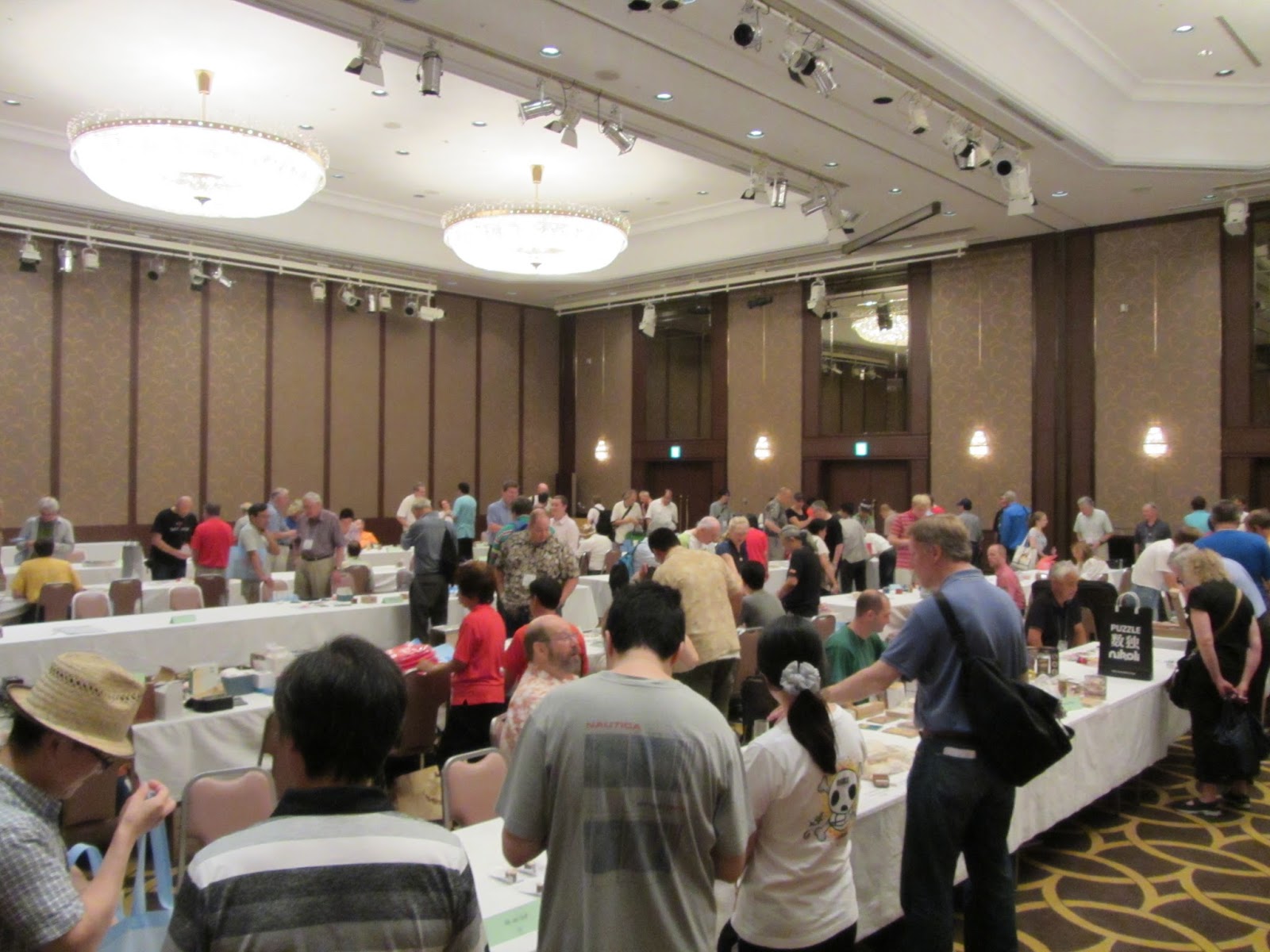
I poked my head over the crowd enough to see that there wasn't really anything I could live without, which was fortunate since it would have been tough to actually snag it! Here's the rest of the room, which had three aisles of tables, a bit smaller than last year.


I like to walk up and down the aisles trying to figure out what I'm interested in: so many puzzles and a limited budget! Here's a neat puzzle that wasn't  for sale: it is a reproduction of an ancient Roman puzzle lock. It takes about five steps to open: pretty amazing that it existed so long ago!

Here's my haul for the day, plus some puzzles I was given on Saturday. I'm in the hotel lobby so I'm not sure of the names of everything, but I'll summarize as best I can. In the top row, Allard's Magic Briefcase exchange puzzle (thanks Allard!) and two of Stephen Chin's exchange puzzles (thanks Chinny!). Next row has Tea for Two 3, a great puzzle from the design competition, Peter Hajak's puzzle box exchange puzzle, an interlocking cube puzzle, a non-puzzle koala clip from Brian Young, and two geometric assembly puzzles from Osho (the pink and blue) (thanks Osho!). Rhombic 9L, an interlocking puzzle from Vesa Timonen (thanks Vesa!), and three Hanayama puzzles I didn't have (Cast Harmony, Cast G&G, and Cast Delta). Finally, a two piece take-apart/put-together puzzle, another cube puzzle, ,and Tea for Two 2.


After my bag was full and my wallet was empty, I headed back to the design competition room. There were just a few more hours to play around with the puzzles and submit my ballot for the Puzzler's Choice award.

I had tried every puzzle at this point, so I just spent my time trying to solve some that I hadn't been able to complete or hadn't spent much time with. Alas, there's never enough time and soon the puzzle room was closed.

I forgot to write about it earlier, but there was a neat display in the design competition room with various Hanayama Cast Puzzle prototypes, which was neat to see. Here's part of the table, they had started to clean it up by the time I remembered to take a photo.

There were also display of impossible objects that were created by combining multiple Cast Puzzles. Pretty impressive!


After the design competition room was closed, there was a talk about the history of Hanayama Cast Puzzles. There were three speakers, the first spoke about old cast puzzles from the late 1800's that some of the Cast Puzzles are based on. The second speaker was Oskar van Deventer who spoke about how he worked on the Cast H&H puzzle. Finally, Teddy Sakamoto talked about some interesting facts about cast puzzles, such as which countries have the most sales, both overall, per capita, and per square kilometer!

After the presentation, we had a bit of downtime, but at 7:00 the awards banquet began! We had another great dinner, followed by the presentation of the thank-you gift to Hirokazu Iwasawa the IPP host. It was a neat looking curved surface puzzle by Wayne Daniels.


After that, I actually had the privilege of announcing the location of IPP35! It is supposed to be secret, so I can't actually publish it here, but is was a lot of fun getting to reveal the location. Brett Kuehner and Rob Stegmann are the co-hosts for IPP35, but neither of them could make it so they asked me to give the presentation. Thanks guys!

Next, the IPP34 host presented some details about next year's IPP. Again, no details here since it is supposed to be a secret from non-invitees. It was a great presentation, it even had a bit of magic in it!

Finally, Nick Baxter revealed the winners of the 2013 Puzzle Design Competition! Here are the results (I'll provide more details on each puzzle in a later post): (Photos by Nick Baxter)

Top Ten Vote Getters: (who weren't otherwise recognized)

Tri-Triangle - Takuro Kowasaki


Bucolic Cube - Yashuhiro Hashimoto

Tetracubed - Robert Reid, George Miller, Stan Isaacs

Tri symmetrics - Vladimir Krasnoukhov and Irina Novichkova

Snake Case - Hiroaki Hamanaka

Symmetrick - Vesa Timonen


Honorable Mention:

Slide Twist Twist Slide - Tony Fisher

Galaxy - Bram Cohen


First Prize:


GEAPPLE - Andras Zagyvia

Grand Prize:

Helical Burr - Derek Bosch

Puzzlers Award:

Dancing Shoes - Goh Pit Khiam

A hearty congratulations to al lthe winners! That brings us to the end of the IPP 33! After the banquet was over, we all hung out in the banquet hall and then the lobby. What a great time, I'm sorry that it is over so soon! I'm already looking forward to IPP 34.

I'll be continuing to travel around Japan with Kellian for the next week, so check out my travel blog for that. After I return, I'll run through all the design competition entries with a mini-review of each.

August 3, 2013

IPP33: Arrival and Puzzle Exchange

Kellian and I had been traveling around Tokyo and Nikko a bit before IPP, so check out my travel blog to read about that.

Yesterday Kellian and I made our way from Nikko back to Tokyo for the start of the 33rd International Puzzle Party! We arrived around 4:30 and got registered and settled before heading down to the lobby hang out with fellow puzzlers, most of whom I only get a chance to see once a year!

Vesa Timonen (designer of Cast Loop) was there, with a few of his puzzles. He had two puzzle rings that I don't think I had a chance to try before, as well as a cute interlocking ball puzzle that he gave me. Thanks Vesa!


Roxanne Wong was there too, rocking a massive puzzle ring bracelet/arm band designed by Bram Cohen and Oskar van Deventer. Quite cool!

We all hung out for a while before the founder's reception, where Jerry Slocum gave a short speech and welcomed the new members of IPP. This year, each new invitee was asked to give a quick introduction, which was a great way to see who the new folks were!

As you probably know, my favorite part of IPP is getting to play with the design competition puzzles, so I rushed over to the design competition room as soon as it opened after dinner. There were a bunch of cool puzzles (check out the list here), but unfortunately I only had time to try about 10-15 of them before the room closed at midnight!

The following day was the puzzle exchange, where participants bring a bunch of copies of a single puzzle and exchange it with other participants' puzzles. A great way to get a bunch of new puzzles! I didn't participate, but I assisted Stephen Chin.


Here's the table of exchange puzzles from a bunch of different angles. Too much stuff to talk about it all: Stephen Chin's De Doe Dak Ka is in the center, the jar above and to the left is an impossible object involving Hanayama Cast Puzzles in a jar, and Scott Elliott's Peppermint is the red and white doodad above and to the right of center.


There were two puzzle boxes, which you can see in the photo below: Peter Hajak's Sri Lanka Box (the octagonal wooden shape at 3:00) and Atsushi Katagiri's Cube 2013 in the green box in the center. Unfortunately, nothing by Kathleen Malcolmson or Perry McDaniel this year!


After the puzzle exchange, I camped out in the design competition room for about 6 hours until the banquet at 7:00. Time flies when you're puzzling! There were some lectures, but I decided to skip those and spend more time in the puzzle room.

The banquet was quite tasty, and it was nice getting a bit of a break from puzzling to socialize! As entertainment after dinner, they had a number of magicians and a juggler.


After the show was over, you can probably guess where I ended up: another 2 hours in the design competition room before it closed at midnight. Good thing it closed, or I'd still be there rather that writing this!

Tomorrow, the puzzle party where folks buy and sell puzzles!

November 1, 2012

2012 Rochester Puzzle Picnic (Part 2)

When I left off last time, I had finished working my way through a number of lovely Stickman puzzle boxes that Peter Wiltshire had brought to RPP. After that, I turned my attention to an awesome puzzle that Jim Strayer had brought: The Lost Day, a puzzle chest by Kelly Snache. I had a great time with The Lost Weekend previously, so I was quite interested to see this earlier work.

The chest conceals 16 separate compartments, which are hidden and locked in a variety of creative ways. It is quite a difficult puzzle, so I attempted it with the help of Peter Wiltshire and Brian Young, plus the occasional hint from Jim.

Above is a photo showing how it starts: the basket with three eggs is part of the puzzle! The tricky thing about a puzzle like this, is that it is difficult to tell where to start. Each surface is quite large, and could contain something important! It definitely helped to have another few sets of eyes (and brains)!

The whole thing was a bit of a blur of secret compartments, magnetic locks, and more, so I can't really get too much into the actual details, but suffice it to say that it was a real blast to solve! One of my favorite parts about puzzle boxes is seeing new and unique mechanisms, and creative ways of applying old principles, and this chest was just jam packed!

I think it ended up taking us a good hour or two to finish finding everything, even with some hints from Jim. On your own, without any hints, it could definitely take a day, probably more!

It was getting pretty late at this point, but I couldn't help but try out a few of the exchange puzzles. I picked up Slap Shot Puzzle, Allan Stein's exchange, since it looked pretty unusual. As an experienced puzzle, I didn't find it particularly challenging, since it uses a familiar trick. It is pretty neat because the trick is related to the object, so that was a nice touch.

Next I tried Hyperboloid Six-Piece Burr, Naoaki Takashima's exchange. The goal is to assemble the six pieces into a cube, which pretty much is like your standard diagonal burr design. However, Naoaki mentioned that he recently discovered that a 7th piece could be added as well, and included that in his exchange too! At first, it is a bit tricky to see how a 7th piece could possibly fit, but after a bit of fiddling, I had figured it out. Not too challenging, but a neat idea. I think this may have worked better in a more slippery medium than wood, since the fit is quite snug. Maybe metal or plastic would be good.

Another one that had intrigued me was Encircling the "X" Puzzle, Abraham Jacob's exchange. I liked that it only had two pieces, often these types of puzzles prove to be pretty interesting! It was particularly intriguing since both pieces were rigid, so it doesn't seem to give you a lot to work with.

After a few tries, I was able to get the ring on, but it used a good deal more force than I thought was appropriate. I'm not sure if I did it right, but it seemed like there was only one way to get the ring back off, and it used similar force. Definitely not ideal, since you don't want folks to get into the habit of forcing your puzzles!

Finally, I decided to try Bram Cohen's exchange, Holistic Ring. It is "holistic" because all four bands need to move simultaneously to assemble or disassemble the ring. This contrasts with the typical design, where the outer bands fold outward first.

Throwing caution to the wind, I took the ring apart and scrambled it up. I figured I had done enough puzzle rings to be able to figure this one out, but who knows! It took a bit of work to figure out what went where, since it differs from the traditional design, but I eventually got it figured out. It is neat to see one of his new puzzle ring designs in person!  It would be great to try one in metal, since the pieces would slide together much more smoothly, I would imagine. Of course, that would have probably been prohibitively expensive for an exchange.

At this point I was pretty exhausted, and headed to bed. Jeff's house was so full of puzzlers that Clayton and I ended up sleeping out in his neighbor's motor home, which he was kind enough to loan to Jeff for the occasion! It was pretty neat, I'd never slept in a motor home before! There's something appealing about having everything you need in such a compact space.

Stay tuned for Part 3!