August 4, 2013

IPP33: Puzzle Party and Awards Banquet

Today was the day of the puzzle party, where folks buy and sell puzzles! It is always a bit frenzied when the doors first open and everybody rushes in, trying to figure out what they want to buy before it is gone! Here's a scene from a table selling a bunch of Karakuri Club boxes: it was pretty nuts!

I poked my head over the crowd enough to see that there wasn't really anything I could live without, which was fortunate since it would have been tough to actually snag it! Here's the rest of the room, which had three aisles of tables, a bit smaller than last year.
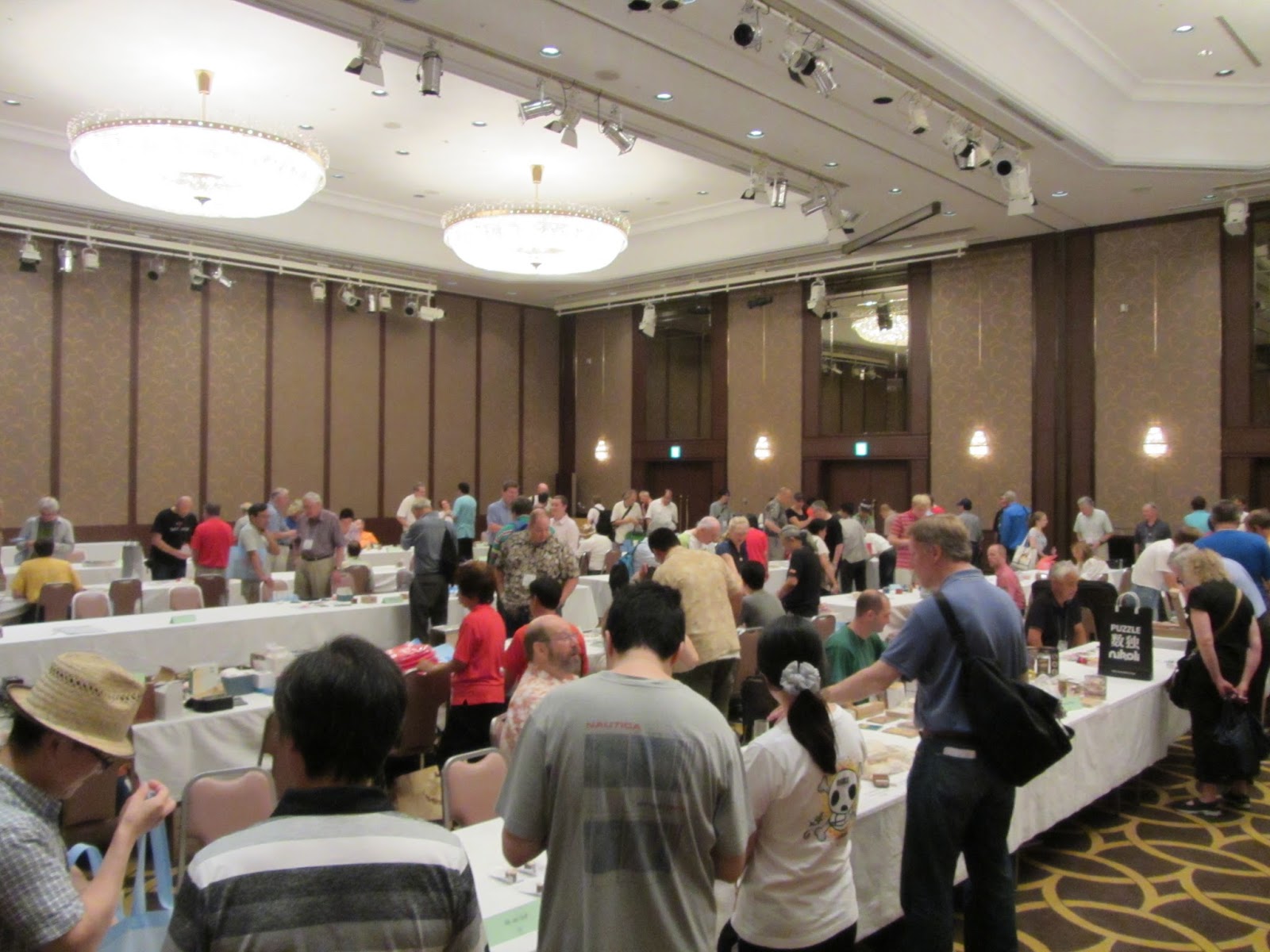

I like to walk up and down the aisles trying to figure out what I'm interested in: so many puzzles and a limited budget! Here's a neat puzzle that wasn't  for sale: it is a reproduction of an ancient Roman puzzle lock. It takes about five steps to open: pretty amazing that it existed so long ago!

Here's my haul for the day, plus some puzzles I was given on Saturday. I'm in the hotel lobby so I'm not sure of the names of everything, but I'll summarize as best I can. In the top row, Allard's Magic Briefcase exchange puzzle (thanks Allard!) and two of Stephen Chin's exchange puzzles (thanks Chinny!). Next row has Tea for Two 3, a great puzzle from the design competition, Peter Hajak's puzzle box exchange puzzle, an interlocking cube puzzle, a non-puzzle koala clip from Brian Young, and two geometric assembly puzzles from Osho (the pink and blue) (thanks Osho!). Rhombic 9L, an interlocking puzzle from Vesa Timonen (thanks Vesa!), and three Hanayama puzzles I didn't have (Cast Harmony, Cast G&G, and Cast Delta). Finally, a two piece take-apart/put-together puzzle, another cube puzzle, ,and Tea for Two 2.


After my bag was full and my wallet was empty, I headed back to the design competition room. There were just a few more hours to play around with the puzzles and submit my ballot for the Puzzler's Choice award.

I had tried every puzzle at this point, so I just spent my time trying to solve some that I hadn't been able to complete or hadn't spent much time with. Alas, there's never enough time and soon the puzzle room was closed.

I forgot to write about it earlier, but there was a neat display in the design competition room with various Hanayama Cast Puzzle prototypes, which was neat to see. Here's part of the table, they had started to clean it up by the time I remembered to take a photo.

There were also display of impossible objects that were created by combining multiple Cast Puzzles. Pretty impressive!


After the design competition room was closed, there was a talk about the history of Hanayama Cast Puzzles. There were three speakers, the first spoke about old cast puzzles from the late 1800's that some of the Cast Puzzles are based on. The second speaker was Oskar van Deventer who spoke about how he worked on the Cast H&H puzzle. Finally, Teddy Sakamoto talked about some interesting facts about cast puzzles, such as which countries have the most sales, both overall, per capita, and per square kilometer!

After the presentation, we had a bit of downtime, but at 7:00 the awards banquet began! We had another great dinner, followed by the presentation of the thank-you gift to Hirokazu Iwasawa the IPP host. It was a neat looking curved surface puzzle by Wayne Daniels.


After that, I actually had the privilege of announcing the location of IPP35! It is supposed to be secret, so I can't actually publish it here, but is was a lot of fun getting to reveal the location. Brett Kuehner and Rob Stegmann are the co-hosts for IPP35, but neither of them could make it so they asked me to give the presentation. Thanks guys!

Next, the IPP34 host presented some details about next year's IPP. Again, no details here since it is supposed to be a secret from non-invitees. It was a great presentation, it even had a bit of magic in it!

Finally, Nick Baxter revealed the winners of the 2013 Puzzle Design Competition! Here are the results (I'll provide more details on each puzzle in a later post): (Photos by Nick Baxter)

Top Ten Vote Getters: (who weren't otherwise recognized)

Tri-Triangle - Takuro Kowasaki


Bucolic Cube - Yashuhiro Hashimoto

Tetracubed - Robert Reid, George Miller, Stan Isaacs

Tri symmetrics - Vladimir Krasnoukhov and Irina Novichkova

Snake Case - Hiroaki Hamanaka

Symmetrick - Vesa Timonen


Honorable Mention:

Slide Twist Twist Slide - Tony Fisher

Galaxy - Bram Cohen


First Prize:


GEAPPLE - Andras Zagyvia

Grand Prize:

Helical Burr - Derek Bosch

Puzzlers Award:

Dancing Shoes - Goh Pit Khiam

A hearty congratulations to al lthe winners! That brings us to the end of the IPP 33! After the banquet was over, we all hung out in the banquet hall and then the lobby. What a great time, I'm sorry that it is over so soon! I'm already looking forward to IPP 34.

I'll be continuing to travel around Japan with Kellian for the next week, so check out my travel blog for that. After I return, I'll run through all the design competition entries with a mini-review of each.

August 3, 2013

IPP33: Arrival and Puzzle Exchange

Kellian and I had been traveling around Tokyo and Nikko a bit before IPP, so check out my travel blog to read about that.

Yesterday Kellian and I made our way from Nikko back to Tokyo for the start of the 33rd International Puzzle Party! We arrived around 4:30 and got registered and settled before heading down to the lobby hang out with fellow puzzlers, most of whom I only get a chance to see once a year!

Vesa Timonen (designer of Cast Loop) was there, with a few of his puzzles. He had two puzzle rings that I don't think I had a chance to try before, as well as a cute interlocking ball puzzle that he gave me. Thanks Vesa!


Roxanne Wong was there too, rocking a massive puzzle ring bracelet/arm band designed by Bram Cohen and Oskar van Deventer. Quite cool!

We all hung out for a while before the founder's reception, where Jerry Slocum gave a short speech and welcomed the new members of IPP. This year, each new invitee was asked to give a quick introduction, which was a great way to see who the new folks were!

As you probably know, my favorite part of IPP is getting to play with the design competition puzzles, so I rushed over to the design competition room as soon as it opened after dinner. There were a bunch of cool puzzles (check out the list here), but unfortunately I only had time to try about 10-15 of them before the room closed at midnight!

The following day was the puzzle exchange, where participants bring a bunch of copies of a single puzzle and exchange it with other participants' puzzles. A great way to get a bunch of new puzzles! I didn't participate, but I assisted Stephen Chin.


Here's the table of exchange puzzles from a bunch of different angles. Too much stuff to talk about it all: Stephen Chin's De Doe Dak Ka is in the center, the jar above and to the left is an impossible object involving Hanayama Cast Puzzles in a jar, and Scott Elliott's Peppermint is the red and white doodad above and to the right of center.


There were two puzzle boxes, which you can see in the photo below: Peter Hajak's Sri Lanka Box (the octagonal wooden shape at 3:00) and Atsushi Katagiri's Cube 2013 in the green box in the center. Unfortunately, nothing by Kathleen Malcolmson or Perry McDaniel this year!


After the puzzle exchange, I camped out in the design competition room for about 6 hours until the banquet at 7:00. Time flies when you're puzzling! There were some lectures, but I decided to skip those and spend more time in the puzzle room.

The banquet was quite tasty, and it was nice getting a bit of a break from puzzling to socialize! As entertainment after dinner, they had a number of magicians and a juggler.


After the show was over, you can probably guess where I ended up: another 2 hours in the design competition room before it closed at midnight. Good thing it closed, or I'd still be there rather that writing this!

Tomorrow, the puzzle party where folks buy and sell puzzles!

November 1, 2012

2012 Rochester Puzzle Picnic (Part 2)

When I left off last time, I had finished working my way through a number of lovely Stickman puzzle boxes that Peter Wiltshire had brought to RPP. After that, I turned my attention to an awesome puzzle that Jim Strayer had brought: The Lost Day, a puzzle chest by Kelly Snache. I had a great time with The Lost Weekend previously, so I was quite interested to see this earlier work.

The chest conceals 16 separate compartments, which are hidden and locked in a variety of creative ways. It is quite a difficult puzzle, so I attempted it with the help of Peter Wiltshire and Brian Young, plus the occasional hint from Jim.

Above is a photo showing how it starts: the basket with three eggs is part of the puzzle! The tricky thing about a puzzle like this, is that it is difficult to tell where to start. Each surface is quite large, and could contain something important! It definitely helped to have another few sets of eyes (and brains)!

The whole thing was a bit of a blur of secret compartments, magnetic locks, and more, so I can't really get too much into the actual details, but suffice it to say that it was a real blast to solve! One of my favorite parts about puzzle boxes is seeing new and unique mechanisms, and creative ways of applying old principles, and this chest was just jam packed!

I think it ended up taking us a good hour or two to finish finding everything, even with some hints from Jim. On your own, without any hints, it could definitely take a day, probably more!

It was getting pretty late at this point, but I couldn't help but try out a few of the exchange puzzles. I picked up Slap Shot Puzzle, Allan Stein's exchange, since it looked pretty unusual. As an experienced puzzle, I didn't find it particularly challenging, since it uses a familiar trick. It is pretty neat because the trick is related to the object, so that was a nice touch.

Next I tried Hyperboloid Six-Piece Burr, Naoaki Takashima's exchange. The goal is to assemble the six pieces into a cube, which pretty much is like your standard diagonal burr design. However, Naoaki mentioned that he recently discovered that a 7th piece could be added as well, and included that in his exchange too! At first, it is a bit tricky to see how a 7th piece could possibly fit, but after a bit of fiddling, I had figured it out. Not too challenging, but a neat idea. I think this may have worked better in a more slippery medium than wood, since the fit is quite snug. Maybe metal or plastic would be good.

Another one that had intrigued me was Encircling the "X" Puzzle, Abraham Jacob's exchange. I liked that it only had two pieces, often these types of puzzles prove to be pretty interesting! It was particularly intriguing since both pieces were rigid, so it doesn't seem to give you a lot to work with.

After a few tries, I was able to get the ring on, but it used a good deal more force than I thought was appropriate. I'm not sure if I did it right, but it seemed like there was only one way to get the ring back off, and it used similar force. Definitely not ideal, since you don't want folks to get into the habit of forcing your puzzles!

Finally, I decided to try Bram Cohen's exchange, Holistic Ring. It is "holistic" because all four bands need to move simultaneously to assemble or disassemble the ring. This contrasts with the typical design, where the outer bands fold outward first.

Throwing caution to the wind, I took the ring apart and scrambled it up. I figured I had done enough puzzle rings to be able to figure this one out, but who knows! It took a bit of work to figure out what went where, since it differs from the traditional design, but I eventually got it figured out. It is neat to see one of his new puzzle ring designs in person!  It would be great to try one in metal, since the pieces would slide together much more smoothly, I would imagine. Of course, that would have probably been prohibitively expensive for an exchange.

At this point I was pretty exhausted, and headed to bed. Jeff's house was so full of puzzlers that Clayton and I ended up sleeping out in his neighbor's motor home, which he was kind enough to loan to Jeff for the occasion! It was pretty neat, I'd never slept in a motor home before! There's something appealing about having everything you need in such a compact space.

Stay tuned for Part 3!

October 16, 2012

2012 Rochester Puzzle Picnic (Part 1)

A few weeks after IPP, I headed off to another awesome puzzle event: the Rochester Puzzle Picnic! Jeff Aurand hosts it at his house each year, and it is probably my favorite event of the year: I like that it is a fairly small gathering, so you can spend more time with folks; Jeff is big fan of puzzle boxes (as am I) so there often a number of new puzzle boxes to check out; and Jeff is an excellent host and grill-master, so I'm always quite happy and well fed. A big thanks to Jeff for everything!


We had an excellent crowd this year! In the back row starting on the left: Alex, Kelly Snache, Tanya's son Brandon, Peter Wiltshire, Ken Irvine, Jim Strayer, Brian Young (a.k.a. Mr. Puzzle), Brian Pletcher, Jeff Aurand, and Clayton Jones. In the bottom row, starting on the left: Susan Strayer, Tanya Thompson, Sue Young, and Helene Irvine. It was a particular treat to have Brian and Sue Young join us this year all the way from Australia! He and his wife stayed in the US after IPP, so they were able to join us!

This year I came with my friend Clayton, a non-puzzler friend of mine who is quite good at solving puzzles, so I thought he might enjoy coming along as well. It was definitely nice having company for the 8 hour drive! When we arrived Friday evening, folks were already puzzling, so we dove right in.


The first box I tried was by Hiroshi Iwahara named Wave Box (with a crayon). It seemed good to start with since people were remarking that it was incredibly easy. It is fairly large, with a number of thin vertical pieces that presumably would have something to do with the locking mechanism. Nope!

The actual locking mechanism is quite trivial, you'll probably figure it out before you think you've started. The box does do something cool when you open it, but it isn't really worth it in my opinion. To be fair, Iwahara did note in his description that it is easy to open!

Next up, Peter Wiltshire was kind enough to bring a number of boxes from his collection by Robert Yarger. I was quite excited to give these a try, since I've only had the chance to solve a handful of his boxes, but am a big fan of his work.

This first box is The Oakwood Slide Box (Stickman #1). As his first box, how cool could it be? As it turns out, quite cool! There are three compartments that you can access, which are revealed in sequence.    There's a great a-ha! moment with each drawer as you reveal it.

The first drawer wasn't too tough, but I had a bit of trouble figuring out the second one. I think I may have been treating it a bit too gingerly for fear of damaging this awesome puzzle. With a bit of a prod from Peter, I was back on my way and figured out the final drawer, which is another nice surprise. Overall, an awesome box!

The next logical box to try would be Stickman #2 (55 Move Box) and fortunately Peter had brought that as well! This box is much more involved that #1, as you could guess from the move count. What you might not guess from its fairly simple appearance is the unusual nature of the moves required. On a few occasions I discovered a new type of move and chuckled to myself with delight. Very cool!

There are a few sneaky things about this box that make it an excellent challenge. There are four compartments to find, so you need to keep that in mind as you progress along. Another great puzzle box!

Next up, we have Stickman #5 (Takeapart Box a.k.a. The Borg Box). We all have puzzles that really catch our eye when we first see a picture of them, and Borg Box is one of mine. I had always wanted to give one of these a try, so you can imagine my delight that I finally got the chance!

The amazing thing about this box is that it is constructed entirely from interlocking pieces (nearly 80 of them!) and no glue! This is a pretty remarkable feat, and on top of that the box just looks incredible.

I didn't know what to expect in terms of the difficulty of the moves, and as it turns out it is fairly difficult! It is quite non-linear in that there are a number of things you can do at any given point, so you really need to remember what's going on. I got a bit stuck at one point, but managed to figure things out and get the box open.

After opening the box, there is the added challenge of disassembling the box into its individual pieces. Robert highly recommends keeping the pieces from each panel separate if you do this, and charges a fee if you need to ship it back to him for reassembly! I decided that discretion was the better part of valor (and didn't want to spend hours trying to get it back together if I screwed something up) and decided to close it back up without taking any of the panels apart. Maybe someday!

The final Stickman box that I tried was Stickman #7 (The Beast Box). This box consists of four drawers inside a frame. They can be slid back and forth in the frame, but are restricted by a maze that is on each face of each drawer and a pin on the frame. This pin can be moved up and down through the maze by lifting a sliding piece on four faces of the frame, and by moving the drawers in and out you can work the pin through the maze.

The thing that makes it difficult is that the pins are double-sided: each interacts with two drawers! So essentially to solve one maze, you need to also be working your way around the other mazes. Quite complicated! Additionally, the faces of the drawers are different, so depending on how you insert the drawer, the puzzle is harder or easier. It was originally thought that there were 666 possible combinations (hence the name), but it later turned out that the number of settings was 538. Plenty to keep you busy for quite some time!

Fortunately, Peter had left it in one of the easier settings! It is quite a beautiful box, and a good bit smaller than I had expected, given the detail. I had a really though time figuring it out on even the easiest setting! What makes it tricky is that you don't really know what the mazes look like on the inside faces, and those are the ones you are dealing with. So not only are you navigating 8 mazes simultaneously, but you can't see them! With a bit of help from Peter, I eventually extracted the first drawer, but it was quite a challenge! I imagine if you spend more time with it, you start to understand and visualize the interactions better, but I found it to be quite difficult!

A big thanks to Peter for bringing these Stickman boxes, it was awesome to get the chance to try them!

Well that's where I'll leave off for now! Stay tuned for plenty more to come!


August 27, 2012

2012 Puzzle Design Competition (Part 7)

This is the seventh (and final!) part of my series of posts about the puzzles in the 2012 Design Competition that did not win an award. All of the photos are by Nick Baxter from the 2012 Puzzle Design Competition website.

Tritalon - Iwahiro (Hirokazu Iwasawa)

This was another one of the puzzles that I was quite interested in trying, since I'd seen some folks posting about it over on the Renegade forum. The goal is to remove the coin, but it is trapped by three sturdy aluminum pieces connected by metal rods.

I noticed something about this one pretty much immediately that led me to the solution. I think it took me about 2-3 minutes, though a good portion of this was spent actually executing the solution. It does have a bit of a tendency to jam up, which is unfortunately unavoidable due to the design. Still, it is an excellent design and a fun easier one for friends to try. You need to be a bit careful when disassembling it completely to reassemble it properly, but complete disassemble isn't necessary to solve it.

TriTangle - David Pitcher

This is another twisty puzzle  that I unfortunately didn't have the time to make much of an effort on. It looks fairly simple, since it only has three turning axes, however after fiddling with it a bit I didn't make much progress.

Twisted Symmetry - Steve Winter

This is a dexterity maze where the goal is to navigate the ball from the entrance to the exit. It is a bit hard to tell where the entrance and exit are, but if you look closely you'll find them. Steve has also painted symmetric designs on each face using an enamel paint, which adds a bit to the otherwise plain white appearance.

As a puzzle, this one is a bit more complicated than Bare Bones, his other design. I did like the fact that you could actually completely remove the ball from this one, using his interesting lever-release mechanism. Also, when you first introduce the ball to the puzzle, it pops in nicely by pushing a piece aside, but then won't come out until you get to the exit. A nice touch!

Varibyrinth - Rohit Kumar Singh

This is quite a unique puzzle that is a combination of a sliding block puzzle and a maze. The goal is to position the pieces such that the ball can roll from the start to the finish. What I really liked was that rather than just having boring lines painted on the sliding pieces, which would essentially be the same puzzle, there is actually a ball which needs to roll through the maze once you've solved it.

Rohit has also implemented a really neat mechanism that prevents the ball from starting its journey until the pieces are in the correct position. This prevents you from cheating and moving the ball around with the pieces. Once the pieces are in the correct position, a switch on the bottom can be flipped, which moves a gate out of the way and allows the ball to move. I'm not quite sure how it works, but there are little metal balls on the pieces that clearly have something to do with it. Perhaps magnetism? Let me know if you know!

[Update: I heard from Rohit that it actually works like a lock: below each sliding piece is a spring-loaded pin. Only when each piece is the correct position, do the pins properly line up to allow the piece on the bottom to slide. Quite clever!]

As a puzzle, it was a tough challenge trying to figure out the route, but similar to Peanut Gallery, it is much easier to solve on paper and then try to reproduce the solution with the sliding blocks. If you just start sliding blocks around, you'll spend a lot of time trying to get the pieces in a position that may or may not end up being correct.

W8-Variation - Donghoon Pee

The goal of this puzzle is to use all of the eight pieces to build a checkered shape that is the same shape as any of the eight pieces. Pretty neat, since it has eight different goals, and the checkering helps limit the options that you need to try. This one didn't really grab me to spend much time with it, unfortunately. I spent a few minutes, but didn't end up making much progress.

Washington Skyline - William Waite

The goal of this puzzle is to assemble all the pieces in a loop. The pieces contain the parts of an imaginary skyline with iconic DC buildings/monuments. Also hidden in the skyline are three presidents' profiles, so the challenge is to find those as well.

I found this to be a pretty tough assembly puzzle, since there are a bunch of pieces and they all fit together. The only way to tell whether you've got it right is whether the skyline makes sense: the buildings should all end up upright. Pretty neat!

With Luck or Effort - Ichiro Kohno

The goal of this puzzle is to get the ball onto the end of the stick (as in the photo). You can either do it by trying to be lucky (with luck), or with dexterity (with effort). I went with the dexterity route and ended up making it on my first try! There is a groove on the edge of the rod, so it stays in there fairly nicely. You just need to keep it from rolling off the far end. Not much of a challenge, so I didn't much care for this one.

W-Toast - Osanori Yamamoto

The goal of this puzzle is to assemble the four identical pieces within the frame. Sounds simple enough, but getting that last piece in there was quite tricky! There's plenty of rotational moves required.

The craftsmanship is quite nice, I liked the use of contrasting wood on the corners of the frame as well as on the blocks connecting the two L-shaped parts of each piece.

XXXII - Sándor Bozóki

The goal of this puzzle is to to balance the 32 sticks on top of the Washington Monument. It is similar to the classic nail balancing puzzle, but is a bit trickier because you don't have the heads on the nails to use. I found it to be quite a dexterity challenge to get the sticks assembled in the proper shape, since they tend to fall apart or slip out of position. Pretty neat!


Well that brings us to the end of my series of posts on the 2012 Puzzle Design Competition puzzles! I hope you've enjoyed reading them! I'll be on vacation for the next week, but when I return I'll be writing about the awesome weekend I just at at the Rochester Puzzle Picnic.